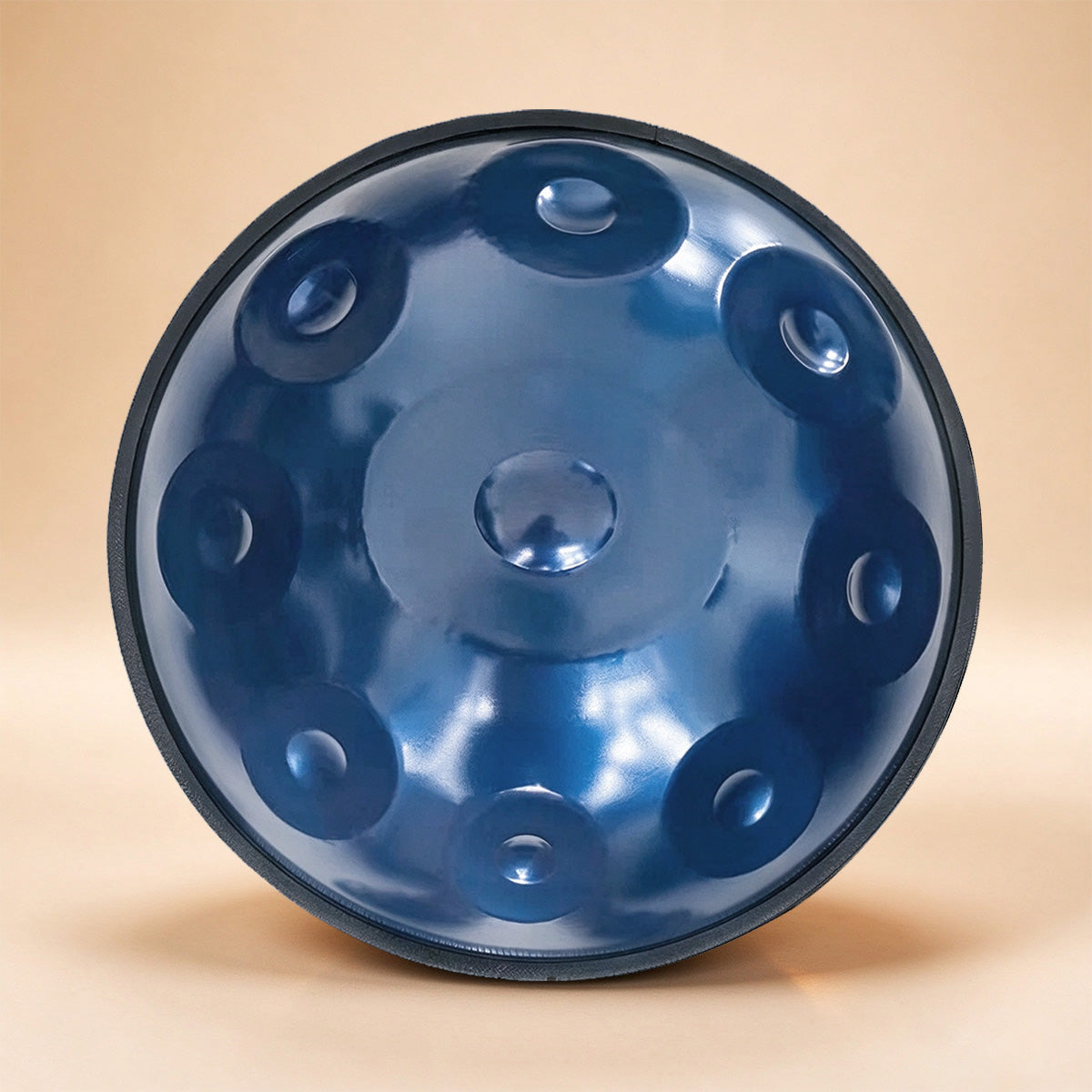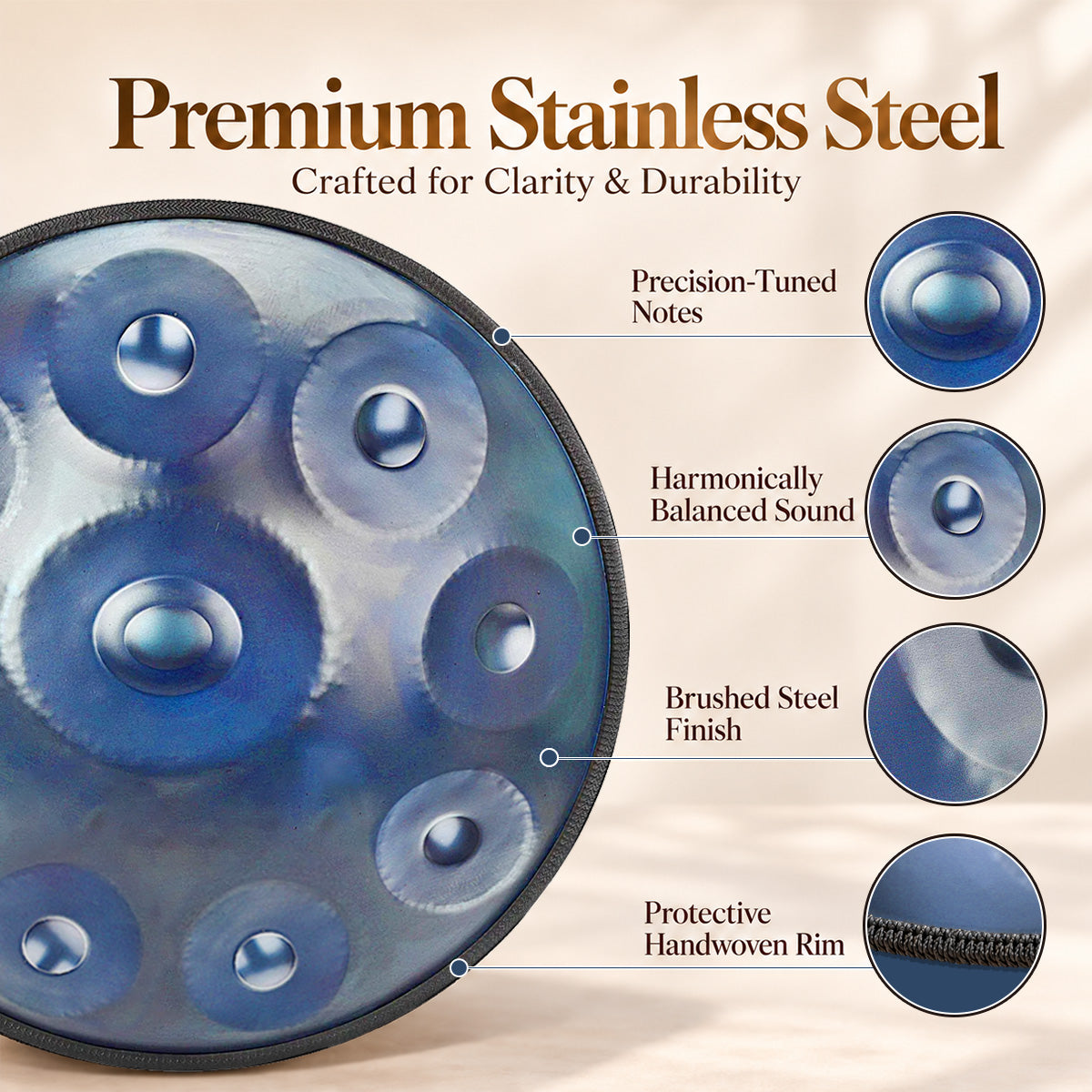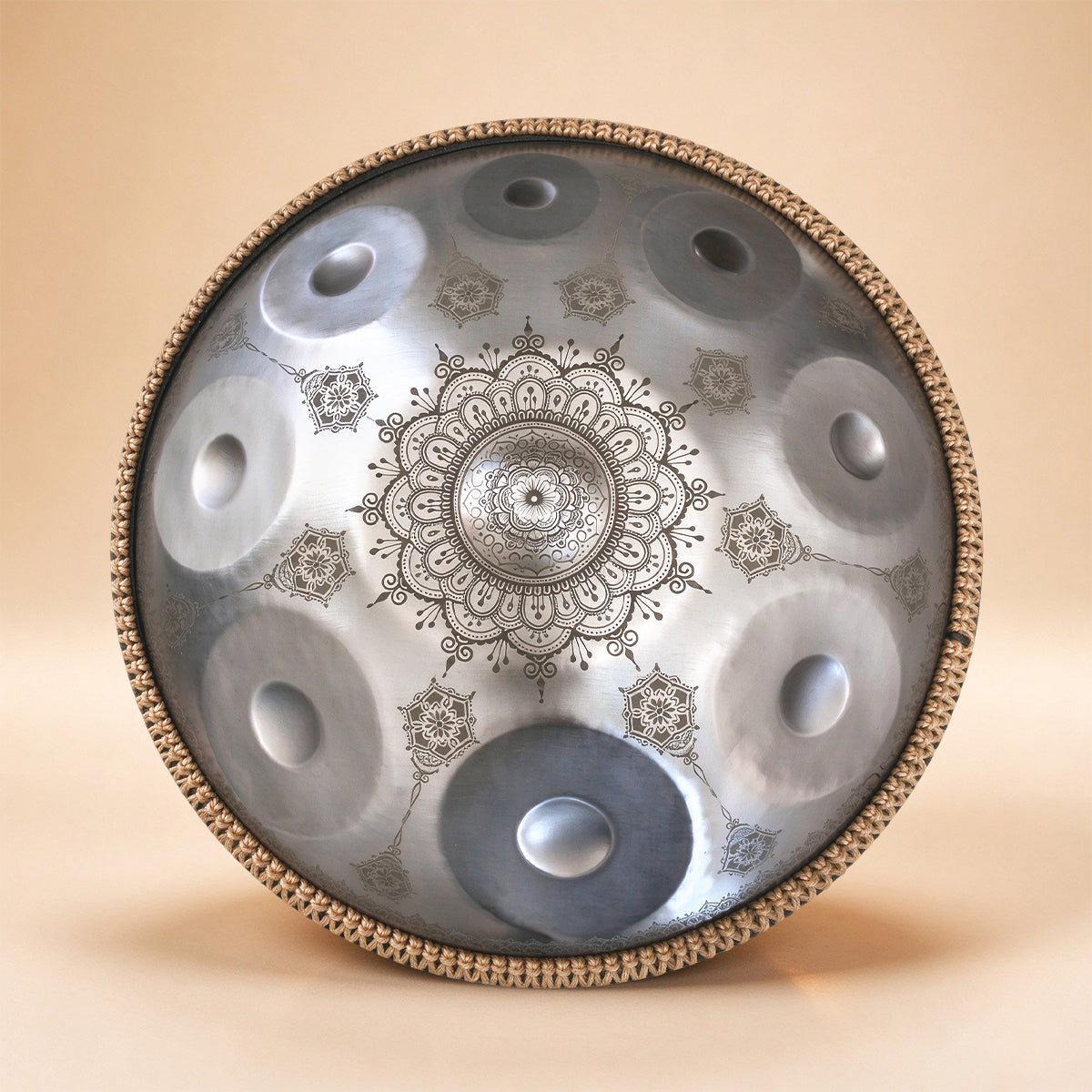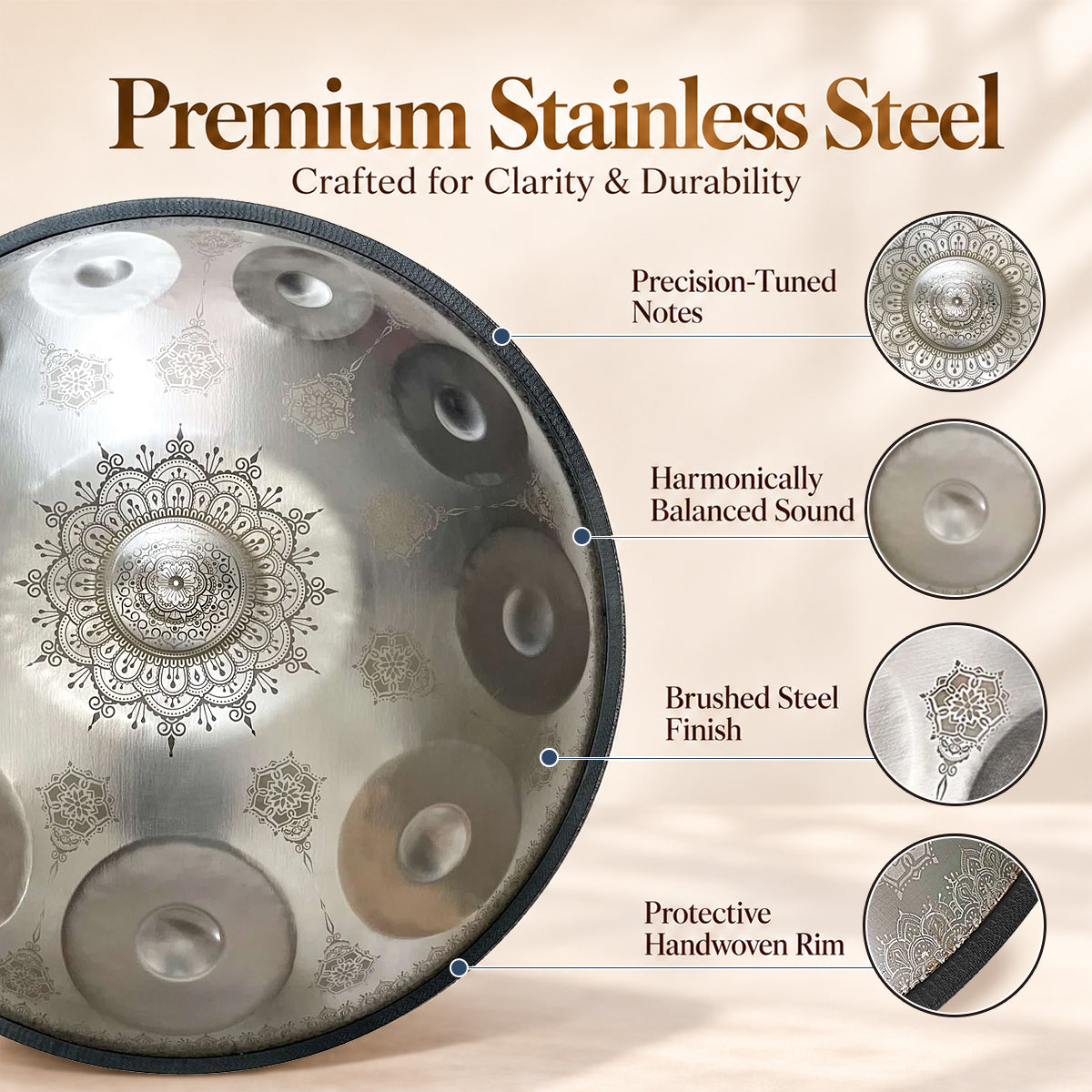
D Minor handpans are popular because they offer a warm, reflective sound and a note layout that makes expressive improvisation accessible. Their appeal is not simply that they sound relaxing. A well-made D Minor handpan gives players a practical combination of musical flexibility, intuitive note relationships, recognizable melodic character and enough depth to support years of development.
However, not every D Minor handpan sounds or plays the same. Note count, tuning frequency, steel quality, sustain and craftsmanship all affect the experience. If you are choosing your first instrument, buying a handpan as a meditation companion or upgrading for more serious playing, understanding these five characteristics will help you avoid paying for specifications that do not improve the music you can actually make.

The five defining characteristics are a D-centered minor scale, a warm and introspective musical mood, an intuitive arrangement of notes around the central Ding, flexible melodic and rhythmic possibilities, and a sound shaped by precise tuning and instrument craftsmanship. D Minor is especially suitable for beginners, improvisation, meditation and expressive solo playing. Before buying, compare the note layout, tuning stability, sustain, playing feel and overall build quality rather than choosing by scale name alone.
1. The 5 Key Characteristics of D Minor Handpans
A D Minor handpan is more than a steel instrument with a particular scale label. Its musical identity comes from the relationship between the notes, the way those notes are arranged around the central Ding, and the tuning quality that allows them to work together. These are the five characteristics that matter most when evaluating one.
Characteristic 1: A D-Centered Minor Scale
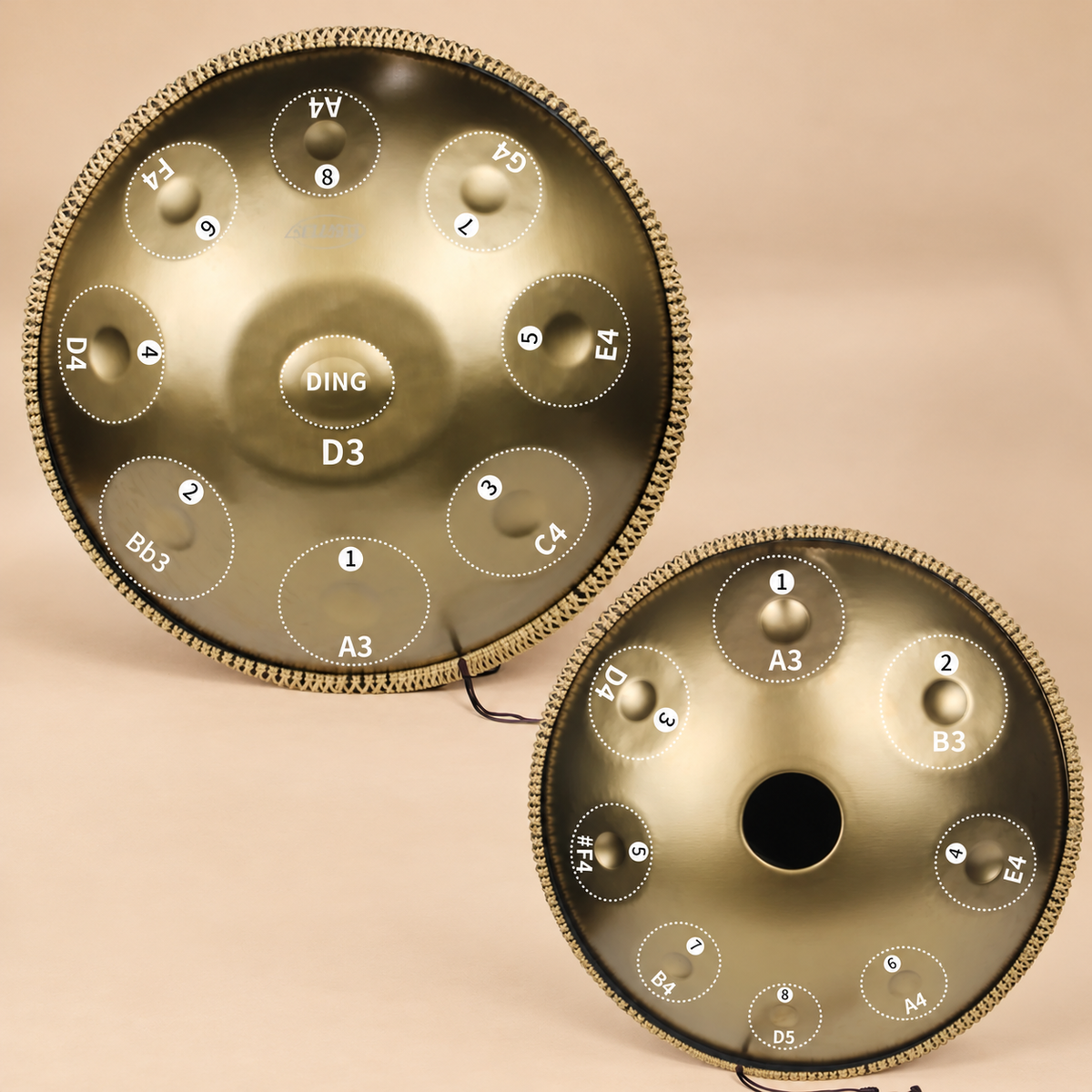
The first defining characteristic is its tonal center: D. A common D Minor handpan layout uses notes drawn from the D natural minor scale, also known as the Aeolian mode:
D – E – F – G – A – B♭ – C – D
The D note provides the tonal home, while the other notes create a minor-scale sound. The F gives the scale its minor third, and the B-flat contributes to its characteristic color. This combination makes it easy to create melodies that feel reflective, atmospheric and expressive without requiring complex music theory.
Not every instrument labeled D Minor has exactly the same note arrangement. Some models include additional notes, octave variations or alternative layouts. Always inspect the actual note chart before buying. If you are still learning to identify pitches and note relationships, our guide to understanding handpan notes is a useful starting point.
Characteristic 2: A Warm, Reflective and Expressive Sound
D Minor is often associated with a thoughtful, mellow and emotionally expressive character. It can work beautifully for slow melodies, ambient music, meditation sessions and improvised compositions. The minor tonality provides a recognizable sense of depth, but it does not force every performance to sound sad or serious.
Rhythm, tempo, dynamics and the notes a player emphasizes all influence the final mood. A D Minor handpan can produce gentle, spacious music with soft strikes, or a more energetic rhythmic pattern when played with stronger accents and faster combinations.
From our perspective, this versatility is one of the scale's strongest selling points. Beginners can create coherent musical phrases without memorizing complicated chord progressions, while experienced players can explore more nuanced phrasing, timing and dynamics.
Characteristic 3: An Intuitive Note Layout Around the Ding
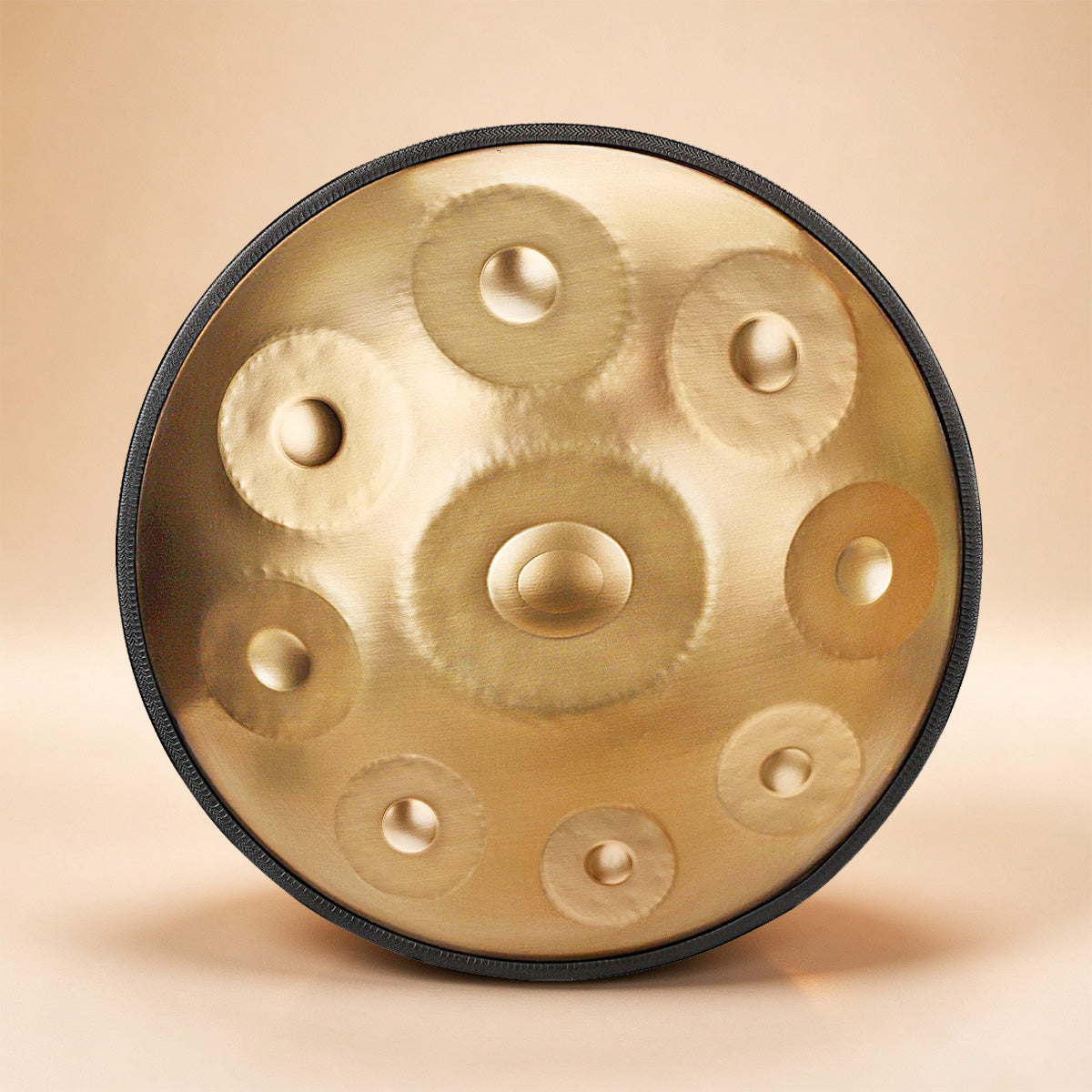
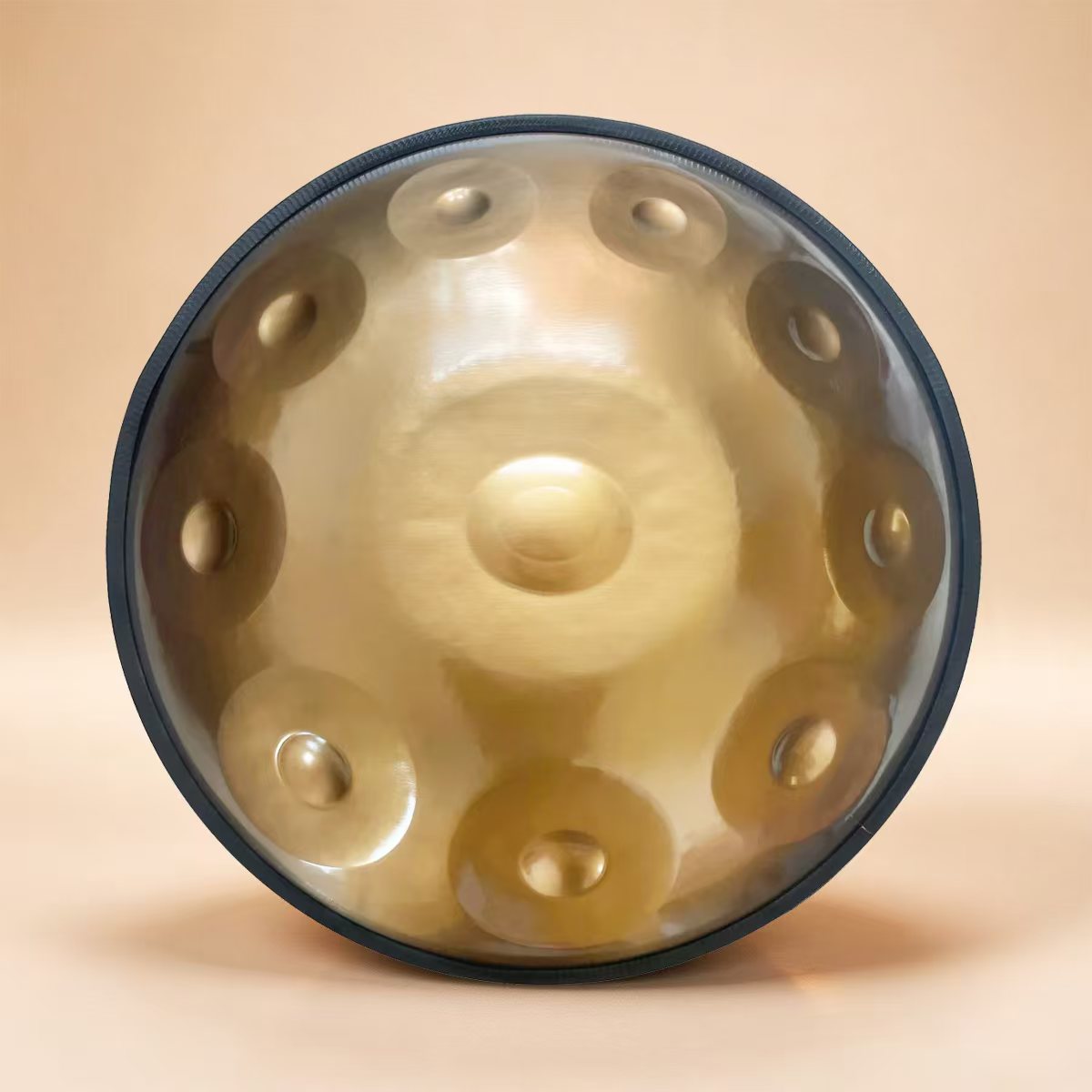
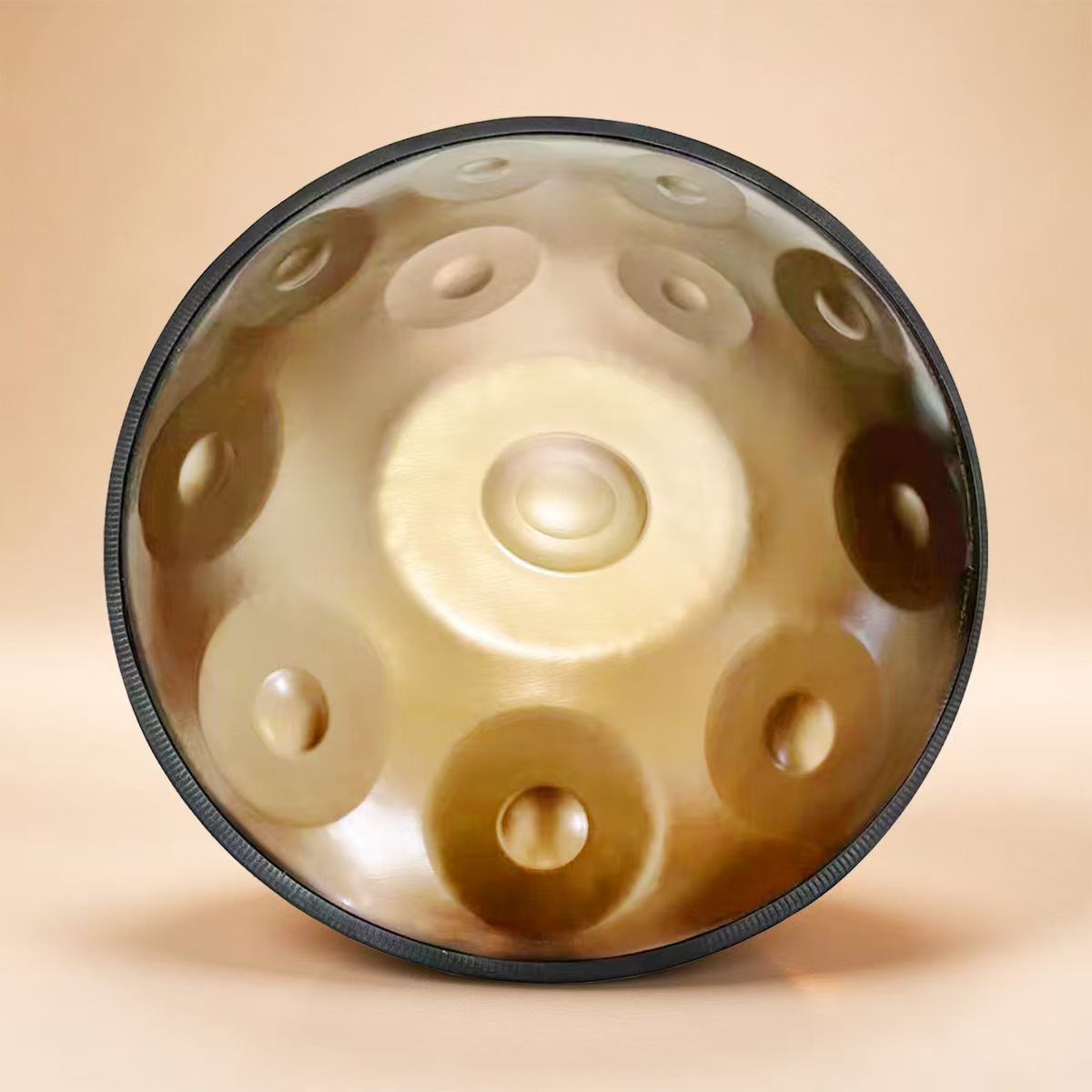
Most handpans place a central note, commonly called the Ding, in the middle of the upper playing surface. Other tone fields are arranged around it. On a D Minor handpan, the layout is designed to make the notes of the scale accessible through hand movements and combinations of strikes.
This arrangement supports intuitive improvisation. A player can move between neighboring notes, return to the Ding and build simple musical phrases without needing to read sheet music. The instrument's layout also encourages rhythmic patterns using alternating hands.
However, intuitive does not mean technique is irrelevant. Striking too hard, hitting the wrong part of a tone field or using inconsistent finger contact can produce weak or uncontrolled sound. A good instrument should respond clearly to light, controlled playing. Beginners should prioritize even response across the note fields rather than chasing a large note count.
Characteristic 4: Flexible Melodic and Rhythmic Possibilities
A D Minor handpan can support both melodic and rhythmic playing. A player can create a slow sequence around the Ding, repeat a short motif, add bass-like accents or use alternating-hand patterns to create a flowing pulse.
Because the scale provides a defined set of notes, many combinations sound musically compatible when played within the instrument's intended scale. This makes it useful for improvisation, especially for people who have little formal music training.
For more advanced musicians, the real challenge is not finding notes that work together. It is developing variation. Repeating the same sequence can quickly make a performance predictable. Dynamics, silence, note duration, rhythmic displacement and changes in emphasis are what turn simple patterns into expressive music.
Characteristic 5: Sound Quality Depends on Precise Tuning and Craftsmanship
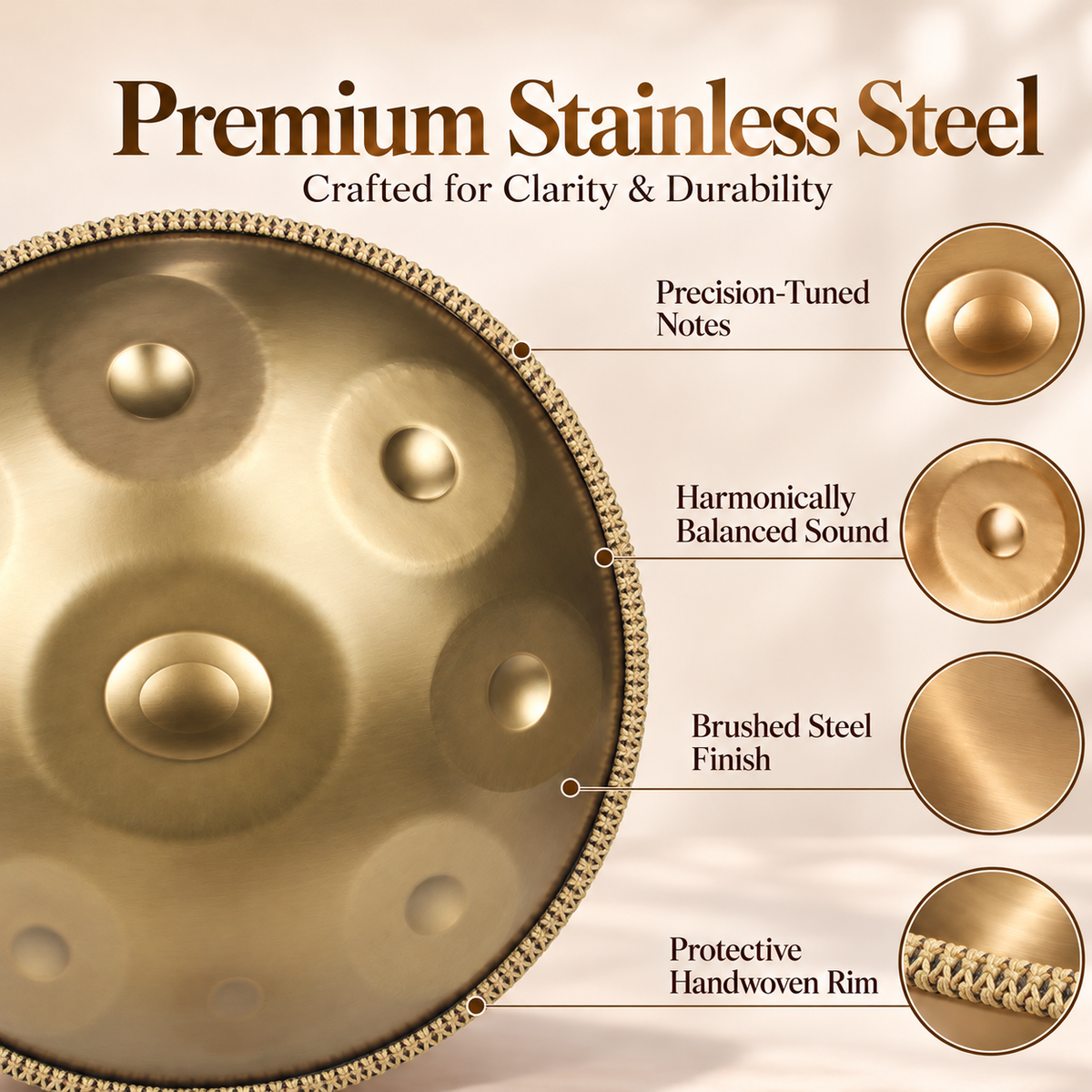
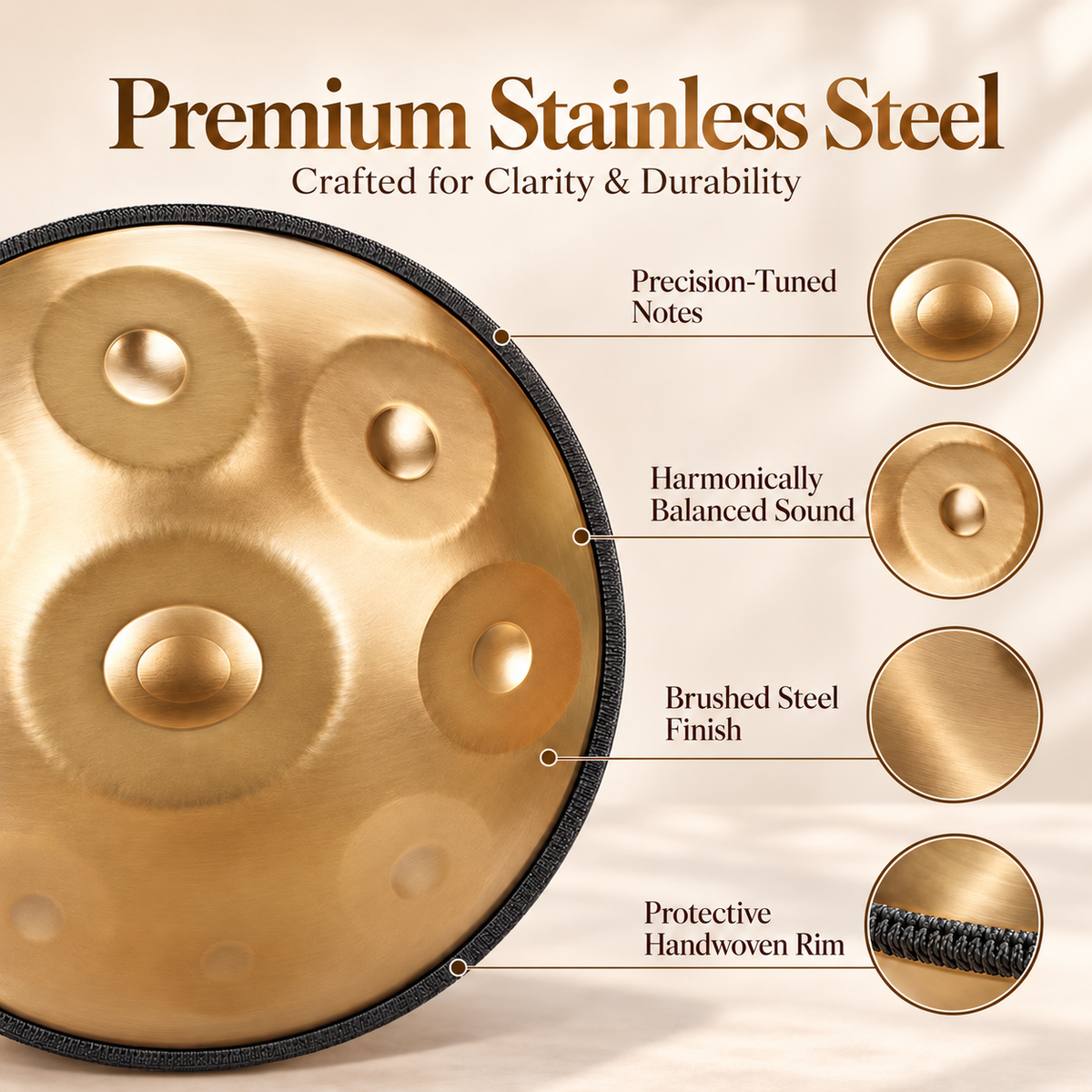
The scale name tells you which notes the instrument is intended to produce. It does not tell you whether those notes are accurately tuned, balanced in volume or pleasant to play. These qualities depend on the maker's forming, heat treatment where applicable, tuning work, material selection and final quality control.
A well-crafted D Minor handpan should have clear note definition, controlled sustain and a balanced response across the playing surface. Notes should not sound obviously unstable or clash with one another when played in normal combinations. The central Ding should also feel integrated with the surrounding notes rather than disconnected from them.
We recommend listening to recordings of the exact instrument whenever possible. A short video showing several notes played individually and in combination is more useful than a generic sound sample from another handpan in the same scale.
2. What Is a D Minor Handpan?
A D Minor handpan is a convex steel percussion instrument tuned to a collection of notes centered on D and commonly based on the D natural minor scale. Players produce sound by striking the tuned tone fields with their hands or fingers. Each field is shaped and tuned to create a specific pitch, while the body of the instrument contributes resonance and sustain.
Unlike a conventional drum, a handpan is designed to produce distinct musical pitches. Unlike a keyboard, however, its note arrangement is not linear. The playing surface places notes in a circular or radial layout, encouraging movement between pitches and rhythmic patterns.
What makes D Minor different from other handpan scales?
Different scales create different musical possibilities. D Minor is a common choice because it has a recognizable minor sound and offers a useful balance between accessible improvisation and expressive depth. Major scales often create a brighter tonal impression, while other minor or modal scales can sound more unusual, tense or atmospheric.
There is no objectively best handpan scale. The right choice depends on the music you want to play and whether you prefer a familiar tonal character or a more distinctive musical palette. If you are comparing instruments, review our handpan notes chart to understand how different note layouts affect playing options.
3. How the D Minor Handpan Note Layout Works
The D Minor scale provides the pitch collection, but the physical arrangement of the tone fields determines how comfortably a player can access those pitches. Most standard handpans place the Ding in the center and distribute the remaining notes around it.
The Ding: the tonal anchor
The central Ding is typically the lowest or one of the lowest notes on the instrument. On a D Minor handpan, it commonly provides the D tonal center. Returning to the Ding helps create a sense of resolution, particularly when improvising short melodic phrases.
The surrounding tone fields
The surrounding notes provide the material for melodies, accents and rhythmic patterns. A 9-note instrument may offer enough range for simple compositions and beginner practice. Instruments with more notes can expand the available melodic range, but they also require more familiarity with the layout.
Why note layout matters more than the number alone
Two handpans can both have nine notes and still feel different to play. The location of each tone field, the spacing between them and the instrument's response affect how naturally a player moves across the surface. A practical layout should let you reach frequently used notes without awkward hand positions.
Before choosing a model, compare the actual note chart rather than relying only on a product title. Our guides to how many notes a handpan should have and standard handpan size explain these buying decisions in more detail.
4. The Sound and Emotional Character of D Minor
D Minor is often selected by players who want an instrument that can produce reflective melodies without sounding musically restrictive. Its minor tonality creates a particular emotional color, but the final result depends heavily on the player's approach.
For meditation and relaxation
Slow, spacious playing can make D Minor a suitable choice for meditation sessions, breathing exercises and quiet personal practice. Sustained notes allow the sound to develop after each strike, while pauses create room between phrases. For this use, a controlled sustain and a smooth, balanced tone are generally more important than having the largest possible note count.
For beginners and casual musicians
The scale can be approachable because players can experiment with notes from a related pitch collection and often create coherent-sounding phrases without formal music training. That does not mean every combination will sound equally satisfying. Beginners still benefit from learning basic timing, touch and simple melodic structures.
For performances and recording
For small performances, recording or collaboration, tuning stability and consistent note volume become more important. A note that sounds beautiful in isolation may become distracting if its pitch or sustain behaves differently from the rest of the instrument. Ask for clean recordings in a quiet room and, where possible, hear the instrument played both softly and with stronger accents.
Ask the seller for a recording that includes every note played individually, a slow melody, a repeated rhythmic pattern and several notes played in succession. Listen for pitch consistency, buzzing, unwanted rattling, uneven volume and whether the sustain feels controlled rather than excessively long or abruptly cut off.
5. Note Count: 9-Note, 10-Note and Extended D Minor Handpans
Note count is one of the most visible differences between handpan models, but more notes do not automatically mean a better instrument. The best choice depends on your current ability, the music you want to create and how much complexity you are ready to manage.
| Handpan configuration | Best for | Main advantage | Potential limitation |
|---|---|---|---|
| 9-note D Minor | Beginners, meditation and simple improvisation | Clear, manageable note layout | More limited melodic range |
| 10-note D Minor | Players wanting an additional pitch option | More flexibility without a major increase in complexity | Requires learning the added note's position |
| 12-note D Minor | Intermediate players and more varied compositions | Expanded melodic possibilities | More demanding layout and technique |
| Extended-note layouts | Experienced players and specific musical arrangements | Greater range and compositional options | Higher learning curve and potentially higher price |
For most first-time buyers, we recommend a well-tuned 9-note or 10-note handpan rather than paying extra for an extended layout. A smaller instrument gives you enough material to develop timing, touch and melodic confidence. Once you can use the available notes creatively, additional pitches become more valuable.
Cosmos Handpan offers different collections for different experience levels. Explore the 9-note beginner handpans, 10-note handpans and 12-note handpans to compare layouts and intended playing levels.
6. 432Hz vs 440Hz: Which D Minor Handpan Tuning Should You Choose?
Handpan buyers often encounter two tuning references: 432Hz and 440Hz. These numbers refer to the tuning reference used for the A note, not the frequency of every note on the instrument. A D Minor handpan tuned to 432Hz and one tuned to 440Hz can share the same scale pattern while using slightly different pitch references.
440Hz tuning
440Hz is the widely used modern concert pitch reference. It is generally the practical choice if you plan to play with instruments, recordings or musicians using standard tuning. If collaboration is important, 440Hz usually makes matching other instruments more straightforward.
432Hz tuning
Some players prefer 432Hz for personal listening, meditation or aesthetic reasons. It can be a valid preference, but it should not be treated as a scientifically proven route to better health, deeper healing or superior relaxation. Those claims go beyond what the tuning reference alone can establish.
| Factor | 432Hz | 440Hz |
|---|---|---|
| Reference pitch | A4 tuned to 432Hz | A4 tuned to 440Hz |
| Musical scale | Can use the same D Minor note relationships | Can use the same D Minor note relationships |
| Playing with standard-tuned instruments | May require pitch matching or transposition | Usually easier to match standard concert-pitch instruments |
| Typical buyer priority | Personal preference and solo listening | Versatility and ensemble compatibility |
Our advice is simple: choose 440Hz if you expect to play with standard-tuned instruments or recordings. Choose 432Hz if you have a clear personal preference and mainly play solo. Do not pay a premium because a seller makes unsupported claims about the therapeutic properties of a particular frequency. For more detail, read our guide to handpan frequency terminology and 432Hz handpan guide.
7. Benefits and Limitations of D Minor Handpans
D Minor is a strong all-round scale, but it is not automatically the right choice for every musician. Its advantages are most apparent when the buyer wants a recognizable minor sound and an approachable instrument for improvisation.
Main benefits
- Accessible improvisation: the scale gives beginners a manageable set of notes for creating melodies.
- Expressive tonal character: D Minor works well for reflective, atmospheric and emotionally varied music.
- Useful for solo practice: the instrument can produce complete musical phrases without accompaniment.
- Flexible playing styles: it supports slow melodic work, rhythmic patterns and more developed compositions.
- Multiple note-count options: buyers can choose a simpler or more expanded layout as their skills develop.
Main limitations
- Not every musical style fits: players who primarily want bright major-key melodies may prefer a different scale.
- Limited ensemble compatibility in some contexts: the scale and tuning reference need to match the music and other instruments.
- Quality varies by maker: the D Minor label does not guarantee accurate tuning or balanced sustain.
- Technique still matters: an intuitive layout does not eliminate the need to develop controlled striking and timing.
- Extended layouts can overwhelm beginners: extra notes add options but also increase the learning curve.
8. D Minor Handpan Comparison Table: What Should You Buy?
The following comparison focuses on practical buying priorities rather than suggesting that one configuration is universally superior.
| Buyer profile | Recommended configuration | Why it makes sense | What to prioritize |
|---|---|---|---|
| First-time player | 9-note D Minor | Manageable layout and enough notes to learn core techniques | Stable tuning, comfortable response and a clear note chart |
| Beginner with some musical experience | 9-note or 10-note D Minor | Accessible improvisation with room for additional melodic ideas | Note placement and consistent tone |
| Intermediate player | 10-note or 12-note D Minor | More options for melodic development | Accurate tuning and even sustain across all fields |
| Meditation and relaxation use | 9-note D Minor | Simple note layout and a focused musical palette | Warm tone, controlled sustain and comfortable playing position |
| Performance and collaboration | Layout matched to repertoire | Supports specific arrangements and musical requirements | 440Hz compatibility where standard concert pitch is required |
| Experienced composer | 12-note or extended layout | Greater range for more complex compositions | Exact note map, tuning stability and advanced playing access |
9. D Minor Handpan Pros and Cons
| Pros | Cons |
|---|---|
| Approachable scale for learning basic improvisation | Minor tonality may not suit every musical preference |
| Expressive sound for solo playing and ambient music | May require a different instrument or arrangement for some ensemble work |
| Works with simple melodic and rhythmic patterns | Musical development still requires practice and technique |
| Available in different note counts and tuning references | More notes can make the layout harder to learn |
| Can be suitable for beginners and experienced players | Scale name alone says little about actual instrument quality |
Our conclusion: D Minor is worth considering if you want an expressive, approachable scale with broad solo-playing potential. It is not worth choosing blindly. A well-tuned instrument in a scale you enjoy will serve you better than a more expensive handpan with a note layout that does not match your musical goals.
10. How to Choose a D Minor Handpan: A Practical Buying Checklist
When comparing D Minor handpans, use the following checklist. It is more reliable than judging the instrument by finish, promotional descriptions or the number of notes alone.
1. Confirm the exact note layout
Ask for the full note chart, including the central Ding and every surrounding note. Confirm whether the instrument follows a standard D natural minor layout or includes additional pitches. Do not assume that two instruments with the same scale name have identical layouts.
2. Listen to every note
Request a recording of each note played separately and in combinations. Listen for pitch clarity, buzzing, rattling, uneven volume and unwanted interference. If the seller only provides a short promotional clip, ask for a more complete demonstration.
3. Evaluate sustain and response
Sustain is the length of time a note continues after being struck. Long sustain can create a spacious sound, but excessive sustain may make fast passages muddy. A controlled response that suits your playing style is more important than the longest possible ringing time.
4. Check tuning reference and stability
Confirm whether the instrument is tuned to 432Hz or 440Hz and ask how tuning quality is checked before shipment. Handpans are sensitive instruments. Impact, mishandling and unsuitable storage can affect tuning, so understand the maker's care and support guidance.
5. Check materials, finish and build quality
Ask what steel is used, how the instrument is finished and what care is required. The finish can affect appearance and maintenance, but it should not distract from sound quality and tuning. A beautiful surface is not a substitute for accurate tone fields.
6. Compare the complete package
A carry bag, stand, mallets and cleaning cloth can make a beginner purchase more convenient. However, compare the quality of those accessories and the instrument itself. A bundle is good value only when the included items are useful and the handpan meets your sound and build requirements.
7. Understand warranty and after-sales support
Ask what happens if the instrument arrives damaged or develops a tuning issue. Clarify return conditions, shipping responsibilities, warranty coverage and whether the seller can provide maintenance guidance. For an instrument that requires specialist tuning, support after delivery matters.
11. Recommended D Minor Handpan for Beginners: Cosmos Handpan Golden Elegance
Cosmos Handpan Golden Elegance – 9 Notes D Minor Gift Set
A practical starting point for first-time buyers who want a straightforward D Minor layout and a ready-to-use accessory package.

The Cosmos Handpan Golden Elegance is a 9-note D Minor instrument designed with beginners in mind. Its layout provides a manageable set of notes for learning basic patterns, exploring improvisation and developing a sense of rhythm without the added complexity of an extended-note instrument.
The product is available with 432Hz or 440Hz tuning options. This gives buyers a choice based on whether they mainly play solo or want easier compatibility with standard concert-pitch instruments. The instrument is described as having clear sustain and a smooth, calming tone, making it relevant for personal practice, relaxation and small performances.
Included gift set:
- Protective carry bag
- Handpan stand
- Pair of mallets
- Cleaning cloth
Why we recommend this configuration for beginners: it focuses on the fundamentals that matter at the start: a recognizable D Minor scale, a manageable 9-note layout and practical accessories. New players can spend their time learning touch, timing and melodic phrasing rather than navigating a large number of notes.
Who should consider another configuration? Experienced players who already compose with extended note ranges may prefer a 10-note, 12-note or custom layout. Buyers who plan to perform regularly with other instruments should select the tuning reference that matches their ensemble requirements.
View the Cosmos Handpan Golden Elegance 9 Notes D Minor Gift Set
Cosmos Handpan's wider collections allow buyers to compare instruments by playing level and note count. If you are unsure which configuration is suitable, start with the Cosmos Handpan story and review the product details before making a decision. You can also contact Cosmos Handpan with questions about note layouts, tuning options and accessories.
12. Common Mistakes When Buying or Learning a D Minor Handpan
Mistake 1: Assuming every D Minor handpan sounds the same
The scale defines the pitch collection, not the instrument's complete sound. Steel type, construction, tuning and craftsmanship all influence tone and sustain. Listen to the actual instrument whenever possible.
Mistake 2: Choosing the highest note count available
Extra notes are useful only when you know how to use them. Beginners often progress faster on a manageable layout because they can focus on timing and touch. Upgrade when you have a clear musical reason to expand your range.
Mistake 3: Believing 432Hz is automatically better
432Hz is a tuning preference, not a guarantee of better sound, health benefits or deeper meditation. Choose it because you like the pitch reference and understand its compatibility implications, not because of unsupported marketing promises.
Mistake 4: Confusing long sustain with good sound quality
Long sustain can be attractive, but it can also make fast passages overlap. Listen for controlled decay and clear separation between notes. The best sustain is the one that supports your playing style.
Mistake 5: Ignoring maintenance and handling
Handpans should be handled carefully and protected from impacts, moisture and unsuitable storage conditions. Use the maker's recommended cleaning and care method. Avoid striking the instrument with excessive force or using hard objects that can damage the tuned surface.
13. Expert Recommendation: Is a D Minor Handpan the Right Choice?
For most first-time buyers, a 9-note D Minor handpan is a sensible starting point. It offers enough musical material for basic melodies, rhythmic patterns and improvisation without making the note layout unnecessarily complicated. Its minor character is expressive, and it works well for solo practice, relaxation and small performances.
For intermediate players, a 10-note or 12-note model can be worthwhile when the additional notes support a specific musical goal. Do not upgrade simply because a larger configuration appears more advanced. If you are still developing consistent timing and controlled strikes, improving technique will usually make a bigger difference than adding pitches.
When choosing between 432Hz and 440Hz, select 440Hz for easier compatibility with standard-tuned instruments and recordings. Choose 432Hz when you prefer that reference and mainly play independently. In either case, prioritize accurate tuning, balanced sustain, clear note separation and responsive customer support.
Ultimately, the best D Minor handpan is the one that encourages you to play regularly. A manageable note layout, sound you genuinely enjoy and reliable construction are more valuable than an impressive specification list.
Explore D Minor Handpans at Cosmos Handpan
Looking for a beginner-friendly instrument with an intuitive note layout? Explore the Cosmos Handpan Golden Elegance 9 Notes D Minor Gift Set and compare its tuning options and included accessories.
14. Frequently Asked Questions About D Minor Handpans
1. What are the key characteristics of D Minor handpans?
The five key characteristics are a D-centered minor scale, a warm and expressive tonal character, an intuitive note layout around the Ding, flexible melodic and rhythmic possibilities, and sound quality that depends on accurate tuning and craftsmanship.
2. Is a D Minor handpan good for beginners?
Yes. A 9-note D Minor handpan is often a practical beginner choice because it provides a manageable note layout and supports simple improvisation. Beginners should prioritize tuning quality, responsive tone fields and a clear note chart over a high note count.
3. What notes are in a D Minor handpan?
A common D natural minor scale contains D, E, F, G, A, B-flat and C, with D as the tonal center. Specific handpan layouts may repeat notes in different octaves or include additional pitches, so check the exact note chart for each instrument.
4. Is D Minor a sad-sounding handpan scale?
D Minor is commonly described as reflective or introspective, but it is not limited to sad music. Tempo, rhythm, dynamics and melodic phrasing can make a D Minor handpan sound peaceful, energetic, playful or dramatic.
5. Should I choose a 9-note or 12-note D Minor handpan?
Choose a 9-note model if you are a beginner or want a simple instrument for improvisation and relaxation. A 12-note model is more suitable when you have enough experience to use the expanded range in your compositions. More notes do not automatically mean better sound quality.
6. What is the difference between a 432Hz and 440Hz D Minor handpan?
The numbers refer to the tuning reference for A4. A 440Hz handpan is generally easier to play with standard concert-pitch instruments. A 432Hz model may suit players who prefer that reference for solo practice. The scale pattern can remain D Minor in either tuning.
7. Can I use a D Minor handpan for meditation?
Yes. Its expressive tonal character and sustained notes can work well for meditation and relaxation sessions. A comfortable playing position, controlled sustain and a sound you personally enjoy are more important than claims that a particular frequency has guaranteed therapeutic effects.
8. How do I know if a D Minor handpan is well tuned?
Listen to every note individually and in combinations. Look for clear pitch, balanced volume, controlled sustain and the absence of obvious buzzing or unwanted rattling. Ask the seller about tuning checks, quality control, warranty and support if the instrument develops a problem.
9. Can a D Minor handpan play with other instruments?
Yes, but the other instruments and music need to be compatible with its scale and tuning reference. A 440Hz D Minor handpan is generally easier to match with instruments using standard concert pitch. For a performance, confirm the note collection and arrangement in advance.
References
- MusicTheory.net – Music Theory Lessons. Background on scales, intervals and musical pitch relationships.
- International Organization for Standardization – ISO 16:1975, Acoustics: Standard tuning frequency. Reference for the standard tuning frequency of 440Hz.
- National Institute of Standards and Technology – SI Units and Measurement. Authoritative background on measurement units and frequency-related terminology.
Musical descriptions such as warm, reflective and calming are subjective listening characterizations, not medical or therapeutic claims. Individual handpan note layouts, tuning references and accessories vary by model. Confirm the product specification with the maker before purchasing.