Every aspiring handpan player, sound therapist, and acoustic instrument collector eventually confronts the confusing spectrum of the modern pantam market. You see two instruments online that appear identical in photographs: both feature a central domed Ding, a ring of tuned tone fields around the upper hemisphere, and an open bottom Gu resonance chamber. Yet one is listed on an overseas discount marketplace for four hundred dollars, while the other commands two thousand dollars from an artisan workshop. In the world of acoustic steel idiophones, cosmetic appearances are deceptive. A handpan is not a stamped steel bowl; it is an acoustically coupled pressure vessel where microscopic metallurgy, crystal dislocation density, thermochemical nitriding, and manual hammer micro-shaping dictate whether an instrument sings with crystalline harmonic purity or clatters like a dented oil drum. When evaluating the materials handmade handpan makers utilize, you are analyzing the physics of resonant steel and acoustic architecture. At Cosmos Handpan, we hammer shells, balance compound harmonic ratios, and conduct metallurgical heat cycles daily. Here is our direct practitioner evaluation of the 6 essential craftsmanship and materials handmade handpan pillars that define an elite, heirloom-grade instrument.

Quick Answer: What Defines the Best Craftsmanship & Materials Handmade Handpan?
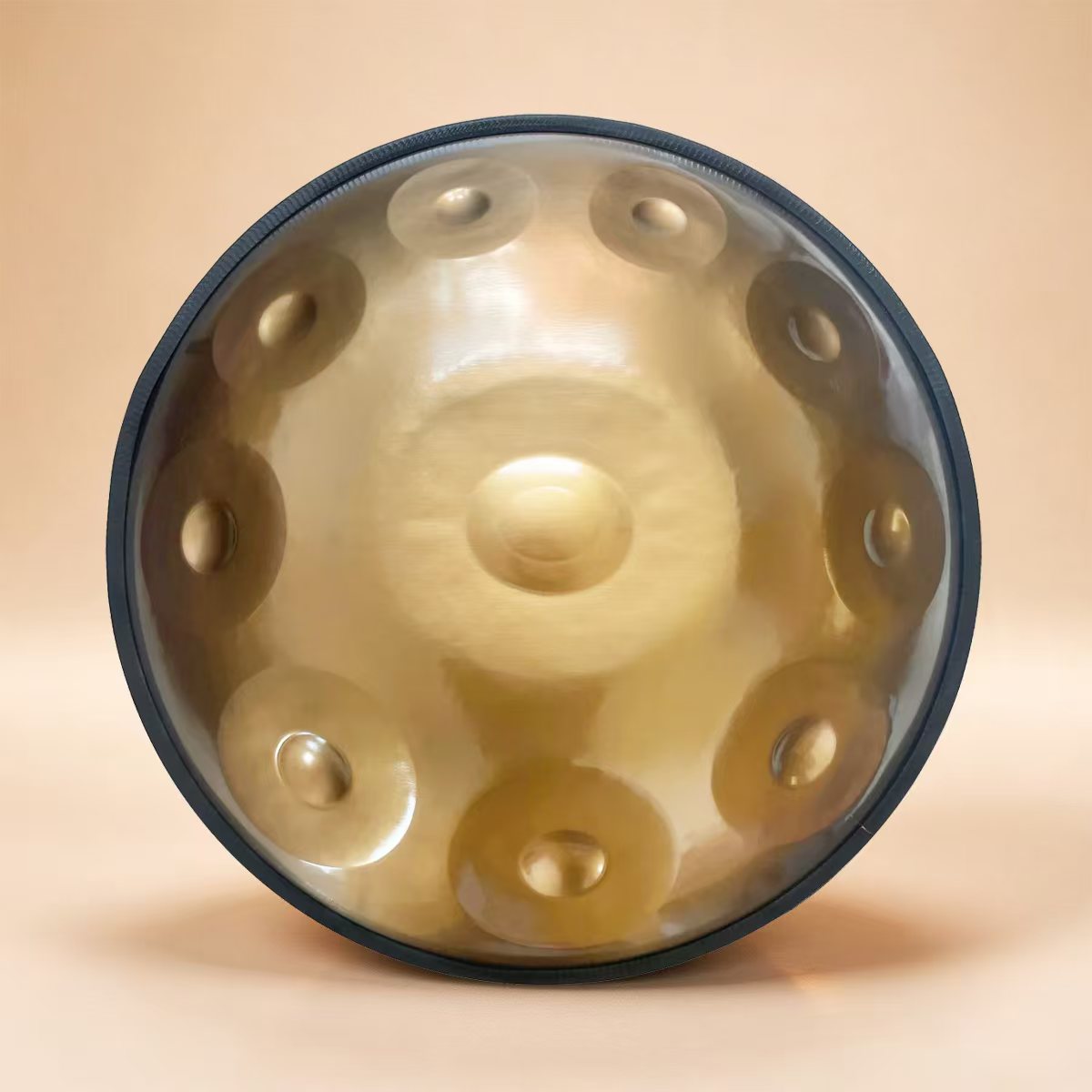
The definitive sonic character, tuning stability, and tactile feedback of a handpan rest upon six foundational metallurgical and craftsmanship pillars: (1) Alloy Grade Selection (choosing between the focused, percussive decay of nitrided DC04 steel versus the lush, singing sustain of austenitic/ferritic stainless steel); (2) Shell Forming & Work Hardening (balancing the acoustic warmth of manual hammer sinking with the dimensional precision of deep-drawn hydroformed shells); (3) Thermochemical Gas Nitriding (case-hardening the metal lattice to stabilize internal tension and eliminate surface oxidation); (4) Tone Field & Interstitial Architecture (hammer-dimpling isolated tone fields with deep boundary troughs to prevent acoustic bleed between adjacent notes); (5) Three-Dimensional Compound Tuning (calibrating the fundamental pitch, 1:2 octave harmonic, and 1:3 compound fifth onto each elliptical tone field); and (6) Anti-Corrosion Passivation & Surface Sealing (employing specialized chemical baths and microcrystalline wax treatments). For players seeking pristine D Minor melodic balance without exorbitant waiting lists, hand-hammered instruments like the Cosmos Handpan Golden Elegance 9 Notes D Minor represent the gold standard of accessible acoustic craftsmanship.
Article Directory
- What It Is: The Physics of Resonant Steel Idiophones
- Quick Summary Table: The 6 Craftsmanship & Materials Pillars
- The 6 Craftsmanship & Materials Handmade Handpan Pillars Analyzed
- Featured Instrument Spotlight: Cosmos Handpan Golden Elegance D Minor
- Direct Technical Comparison: Nitrided Steel vs. Stainless Steel vs. Ember Steel
- Pros and Cons: Hand-Hammered Artisan vs. Factory Stamped Handpans
- Acoustic Coupling: Harmonics, Boundary Traps, and Wave Isolation
- Who Needs a Fine Handmade Handpan vs. Who Should Start with a Tongue Drum
- Costly Mistakes Buyers Make Sourcing a Handpan
- Essential Buying Checklist: Auditing Steel Thickness, Tuning & Scale
- Expert Sourcing Verdict: The Smart Musician's Roadmap
- Frequently Asked Questions
- Authoritative References & Acoustic Engineering Standards
What It Is: The Physics of Resonant Steel Idiophones
To understand the craftsmanship and materials handmade handpan artisans employ, one must look beyond musical romanticism and examine solid-state mechanics. Originating from the Swiss Hang invented in 2000 by Felix Rohner and Sabina Schärer, the handpan belongs to the idiophone family of musical instruments, where sound is produced primarily by the vibration of the instrument's material body without strings or membranes.
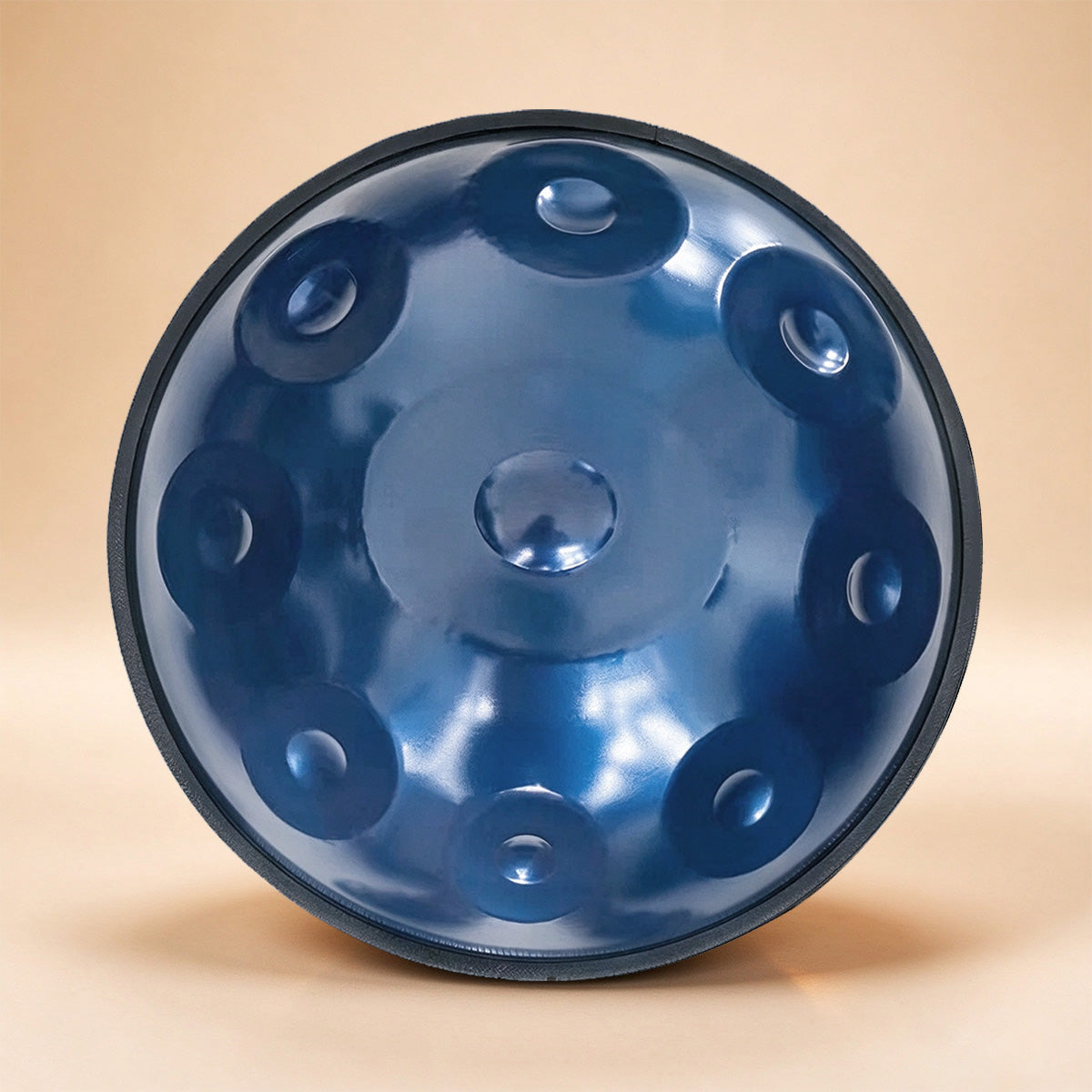
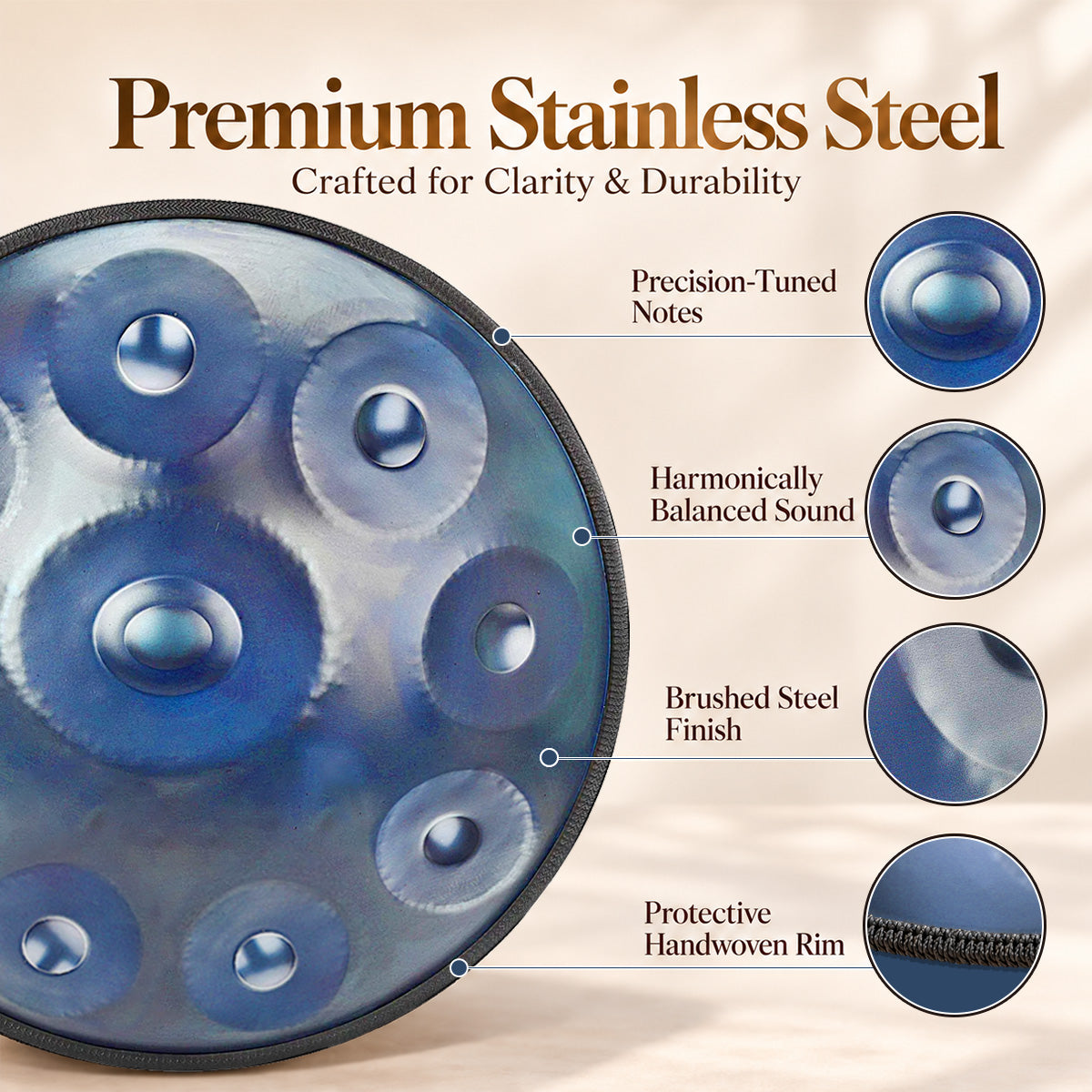
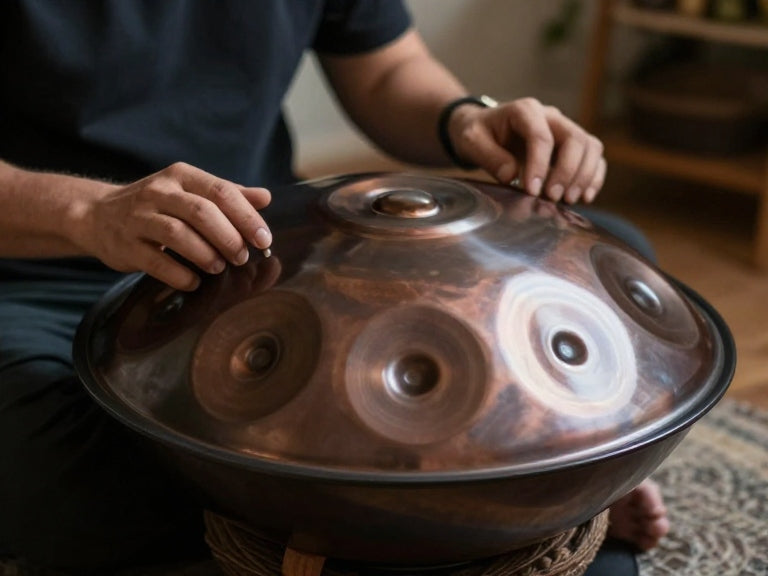
A handpan consists of two cold-formed, hollow hemispherical shells made of thin sheet steel (typically 1.0mm to 1.2mm thick) joined together at the rim by an elastic polyurethane or epoxy adhesive seam. The upper shell (the Ding side) contains several tuned tone fields surrounding a central dome. The bottom shell (the Gu side) acts as a Helmholtz resonator, featuring an open neck port that amplifies the interior air mass, adding deep bass resonance to every strike.
In our testing across acoustic oscilloscopes, a handpan note does not vibrate like a simple bell. Each individual tone field is pressed into an elliptical membrane with a central dimple. When struck by a thumb or knuckle, this single steel membrane must oscillate in three distinct vibrational modes simultaneously:
- The Fundamental Mode ($f_0$): The entire membrane flexes up and down, defining the primary pitch heard by the human ear (for example, D3 at 293.66 Hz).
- The Octave Mode ($2f_0$): The membrane divides along its longitudinal axis, vibrating at exactly double the fundamental frequency (one octave higher).
- The Compound Fifth Mode ($3f_0$): The membrane divides along its transverse axis, vibrating at a frequency ratio of 3:1 relative to the fundamental (an octave plus a fifth).
If the internal grain structure of the materials handmade handpan builders select is inhomogeneous, or if the heat treatment is uncalibrated, these three modes de-synchronize. The note sounds sour, hollow, or out-of-tune immediately. High-end craft is the discipline of tuning those three frequencies onto every single note while mechanically decoupling them from neighboring notes on the shell. If you are exploring scale layouts for the first time, review our primer on the best handpan for beginners.
Quick Summary Table: The 6 Craftsmanship & Materials Pillars
| Craftsmanship Pillar | Primary Material / Technique | Target Engineering Metric | Acoustic & Functional Result | Failure Prevented |
|---|---|---|---|---|
| 1. Steel Metallurgy | DC04 Deep-Drawing vs. Austenitic Stainless | Sheet gauge: 1.0mm – 1.2mm thickness | Dictates sound decay, warmth, and sustain duration | Brittle tearing and unwanted acoustic tinny ringing |
| 2. Shell Sinking | Manual pneumatic hammer sinking vs. Hydroforming | Uniform depth profile and work hardening | Creates structural curvature and tension gradients | Flat dead spots and harmonic distortion |
| 3. Gas Nitriding | Controlled thermo-chemical nitrogen diffusion | Surface hardness > 500 HV; 520°C–580°C | Locks crystalline lattice; stabilizes tuning memory | Rapid detuning and catastrophic atmospheric rust |
| 4. Tone Field Architecture | Elliptical dimpling with isolation interstitial zones | Longitudinal/transverse axis ratio: 1.25 to 1.35 | Isolates fundamental, octave, and fifth vibrational axes | Cross-talk and bleed into neighboring notes |
| 5. Precision Tuning | Pneumatic and hand-hammer micro-peening | Harmonic alignment tolerance within ±3 cents | Delivers crystalline chordal resonance and dynamic response | Dull clunking, wobble, and harmonic dissonance |
| 6. Surface Sealing | High-bake oxidation, PVD, and microcrystalline wax | Hydrophobic and oleophobic barrier layer | Preserves tactile feel and prevents skin sweat acid etch | Corrosive pitting and hand discoloration |
The 6 Craftsmanship & Materials Handmade Handpan Pillars Analyzed
1. Steel Metallurgy & Alloy Selection: Nitrided Steel vs. Stainless vs. Ember
In most professional situations, the very first decision that dictates an instrument's character is the alloy formulation. You cannot build an exceptional instrument out of arbitrary scrap sheet metal. The physical materials handmade handpan artisans select determine structural elasticity, acoustic velocity, and decay rates.
Three dominant steel categories define modern handpan craft:
- Low-Carbon Deep-Drawing Steel (DC04 / 1008 Steel): The heritage choice. Low-carbon steel is soft and malleable, allowing deep deformation without tearing. However, in its raw state, it has zero rust resistance and poor acoustic sustain. It must undergo gas nitriding. Once nitrided, it produces the classic, earthy, warm, and highly percussive handpan tone with short-to-medium sustain. It is the preferred material for fast, rhythmic players who do not want lingering notes to bleed into one another during quick tempo strikes.
- Austenitic & Ferritic Stainless Steel (AISI 304 / 430): The modern singing alloy. Stainless steel incorporates chromium and nickel, giving it extraordinary natural rust resistance and higher internal tensile strength. In our testing, stainless steel delivers an ultra-long, singing sustain that can ring for 8 to 12 seconds per note. The sound is open, cathedral-like, and shimmering with upper harmonics, making it the premier choice for sound baths, personal meditation, and ambient music.
- Ember Steel (Specialized Deep-Draw Stainless Alloy): Developed specifically for handpan construction, Ember steel combines the rust resistance and singing sustain of stainless steel with the grounded, controllable midrange warmth of nitrided steel. It is expensive and difficult to hammer, but offers exceptional dynamic range for advanced performers.
2. Shell Sinking & Shaping: Manual Hammering vs. Precision Hydroforming
Before a flat circle of steel can produce musical pitches, it must be formed into a rigid, hollow hemisphere. This process is called "sinking," and the method chosen fundamentally alters the steel's internal crystalline structure through a physical mechanism known as work hardening (strain hardening).
Artisans utilize two primary methodologies:
- Manual Pneumatic Hammer Sinking: The maker places a flat steel disc over a sunken tire or wooden anvil, using a heavy pneumatic power-hammer to strike tens of thousands of overlapping blows in concentric circles from the perimeter inward. This process requires hours of physical labor. Each hammer blow stretches the atomic grain boundaries of the steel, introducing microscopic dislocations that increase the metal's yield strength. Hand-sunk shells possess an organic, textured surface with slight thickness variations that seasoned players praise for its earthy acoustic complexity.
- Hydroforming and Mechanical Deep Drawing: Using high-pressure hydraulic fluid or hardened steel dies, the metal disc is pressed into a hemisphere in seconds. Hydroforming ensures perfectly uniform wall thickness (accurate to 0.05mm) across the entire dome. In our testing, while purists romanticize pure hand-sinking, modern high-end makers frequently start with hydroformed or deep-drawn raw shells because their dimensional uniformity eliminates structural weak spots, allowing more consistent, predictable tuning of complex upper tone fields.
3. Thermochemical Gas Nitriding: The Key to Tuning Stability
If you take a raw, un-nitrided low-carbon steel shell, tune it to perfection, and play it for an hour, the notes will drift out of pitch within weeks. Unhardened steel exhibits mechanical hysteresis: under the mechanical impact of hand strikes, the steel molecules shift, relaxing the tension and throwing off the tuning.
The solution is Gas Nitriding, an industrial thermochemical case-hardening process governed by standards such as ASM International: Principles of Thermochemical Heat Treatment and Nitriding. In a specialized vacuum furnace sealed with anhydrous ammonia ($NH_3$) gas, shells are heated between 520°C and 580°C for 24 to 72 hours. The ammonia dissociates, diffusing atomic nitrogen deep into the iron lattice:
- The Compound White Layer: A microscopic outer barrier layer (5 to 20 microns thick) composed of iron nitrides ($\epsilon\text{-Fe}_{2-3}\text{N}$ and $\gamma'\text{-Fe}_4\text{N}$). This layer increases surface hardness past 500 to 800 HV (Vickers hardness), creating an impervious shield against moisture and rust.
- The Diffusion Zone: Nitrogen atoms lodge in the interstitial spaces of the underlying steel crystal lattice, creating permanent internal compressive stress. This compressive stress acts like an invisible acoustic spring: it stabilizes the tuned membranes, prevents work-fatigue from aggressive playing, and accelerates the acoustic velocity of sound waves traveling across the shell.
4. Tone Field Architecture: Elliptical Geometry and Boundary Isolation
A handpan shell cannot produce musical notes if it remains a smooth, continuous sphere. If you strike a flat bowl, the entire surface vibrates simultaneously, creating an unmusical, discordant metallic gong sound. To create individual notes, the maker must isolate distinct resonant zones on the shell.
The craftsman maps out tone fields around the circumference. Each tone field is hammered into an elliptical concave depression featuring a raised or inverted central dimple. The physics of this geometry are non-negotiable:
- The Central Dimple: Acts as a rigid physical anchor. It stiffens the center of the tone field, forcing the surrounding membrane to oscillate in predictable circular and transverse wave modes.
- The Interstitial Trough (Tone Border): Around the perimeter of each tone field, the tuner creates a subtle, hammered boundary trough. This trough acts as an acoustic acoustic wave trap. When the player strikes a note, sound waves travel through that specific membrane; when they hit the sharp change in curvature at the interstitial border, the waves reflect backward rather than bleeding into neighboring notes.
- Elliptical Axis Ratio: The longitudinal axis (length) and transverse axis (width) of the ellipse are calculated to a precise ratio (typically 1:1.25 to 1:1.35). This geometric asymmetry forces the membrane to hold two completely different harmonic frequencies at right angles to each other: the octave along the length, and the compound fifth across the width.
5. Acoustic Tuning & Multi-Harmonic Coupling
Tuning a handpan is one of the most intellectually and physically demanding manual crafts on Earth. There is no automated CNC machine or robotic laser that can tune a handpan. It requires an experienced tuner holding polished specialty hammers, listening through calibrated microphones, and physically micro-peening the steel at sub-millimeter increments.
Every single note on a premium handmade handpan contains three distinct frequencies tuned simultaneously onto that one piece of steel:
- The Fundamental ($1f$): The baseline root pitch. Tuned by adjusting the overall depth and tension of the tone field membrane. Hammering the perimeter raises the pitch; hammering the center lowers the pitch.
- The Second Harmonic – Octave ($2f$): Tuned strictly along the longitudinal axis of the ellipse. It must match exactly 12 semitones above the fundamental.
- The Third Harmonic – Compound Fifth ($3f$): Tuned strictly along the transverse axis. It must match exactly 19 semitones above the fundamental.
6. Surface Finishing, Corrosion Passivation & Protective Sealing
The final pillar of handpan craftsmanship is surface chemistry and protection. Human skin naturally secretes acidic perspiration containing sodium chloride, lactic acid, and fatty acids. When these biological acids contact raw steel, galvanic oxidation begins within minutes, leaving brown fingerprint stains that pit the metal and alter tone field mass, throwing the instrument out of tune.
High-end materials handmade handpan workshops employ multi-tier surface sealing:
- High-Bake Oxidation: After tuning, shells are baked in temperature-controlled kilns at 180°C to 220°C. This thermal passivating cycle relieves microscopic stress introduced during tuning while converting surface iron into a protective blue-black or bronze magnetite ($\text{Fe}_3\text{O}_4$) oxide layer.
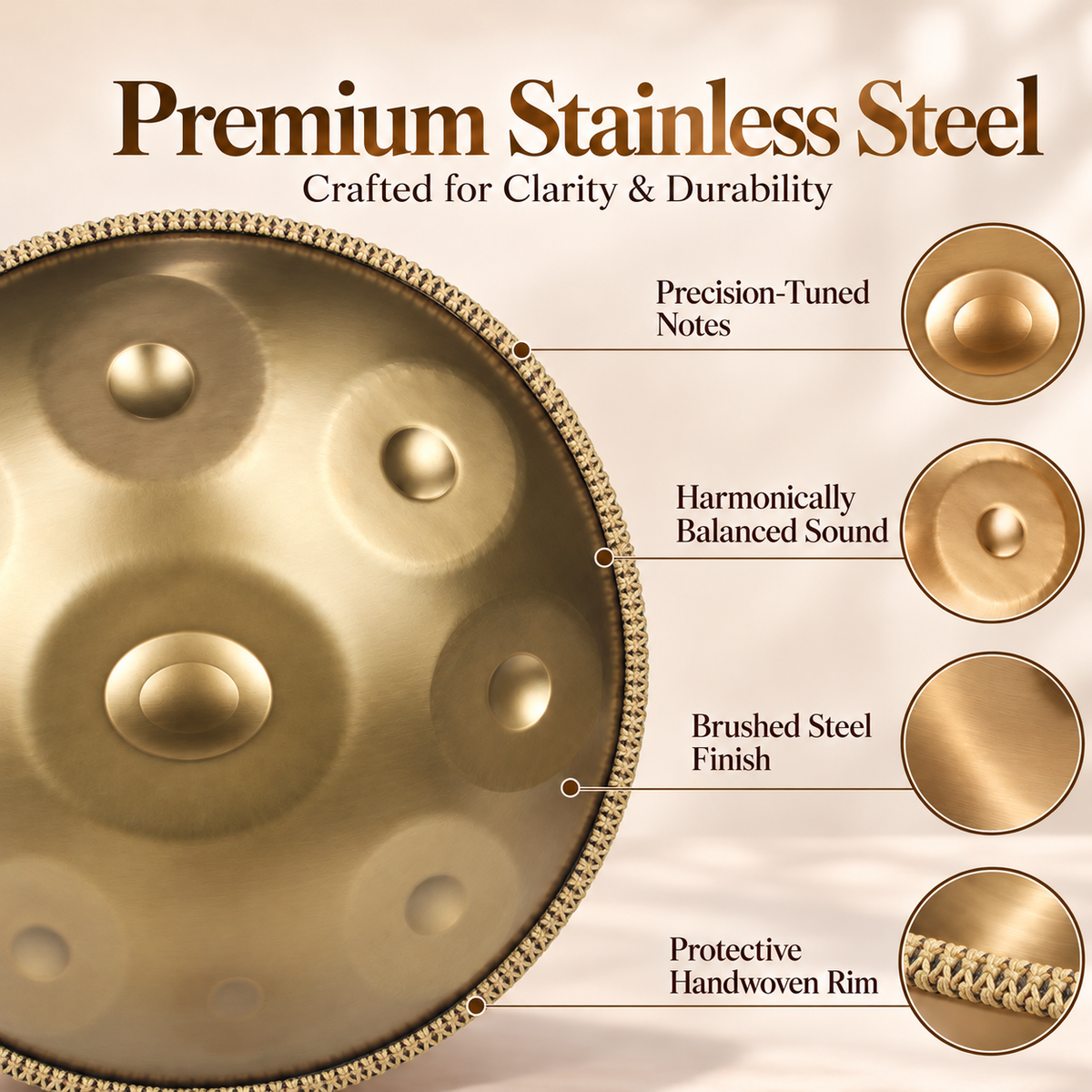
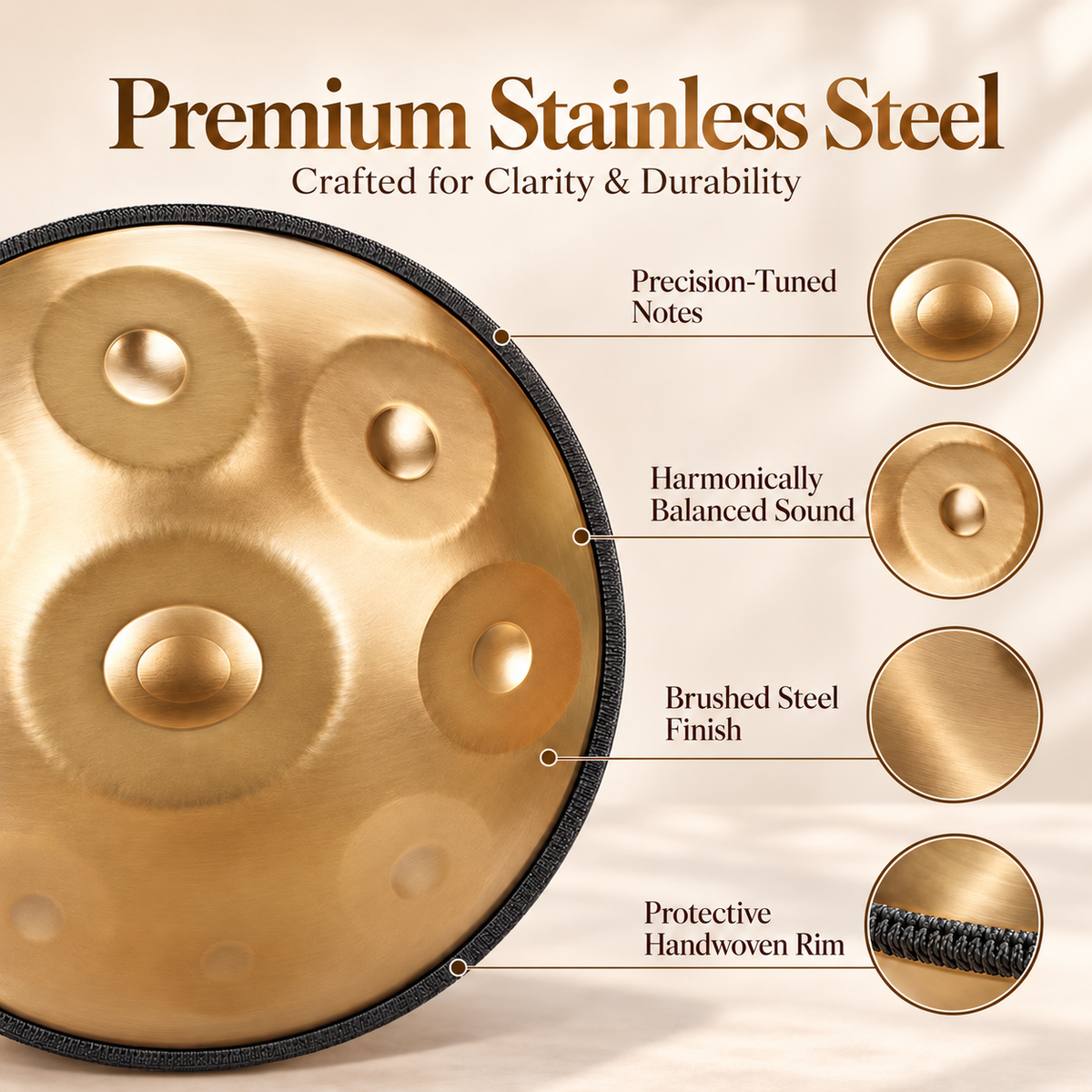
- Physical Vapor Deposition (PVD) Coatings: Applied in vacuum chambers, PVD deposits a ceramic-metallic titanium nitride layer (yielding a brilliant golden or iridescent finish). PVD coatings are micro-thin, highly scratch-resistant, and completely immune to skin sweat, preserving the instrument's visual aesthetic without dampening tone field vibration.
- Microcrystalline Wax Sealing: Before leaving the workshop, instruments are coated with specialized microcrystalline waxes (such as Phoenix Oil or Froglube). These specialized compounds seal the microscopic pores of the nitrided surface, creating a hydrophobic barrier that repels humidity during travel.

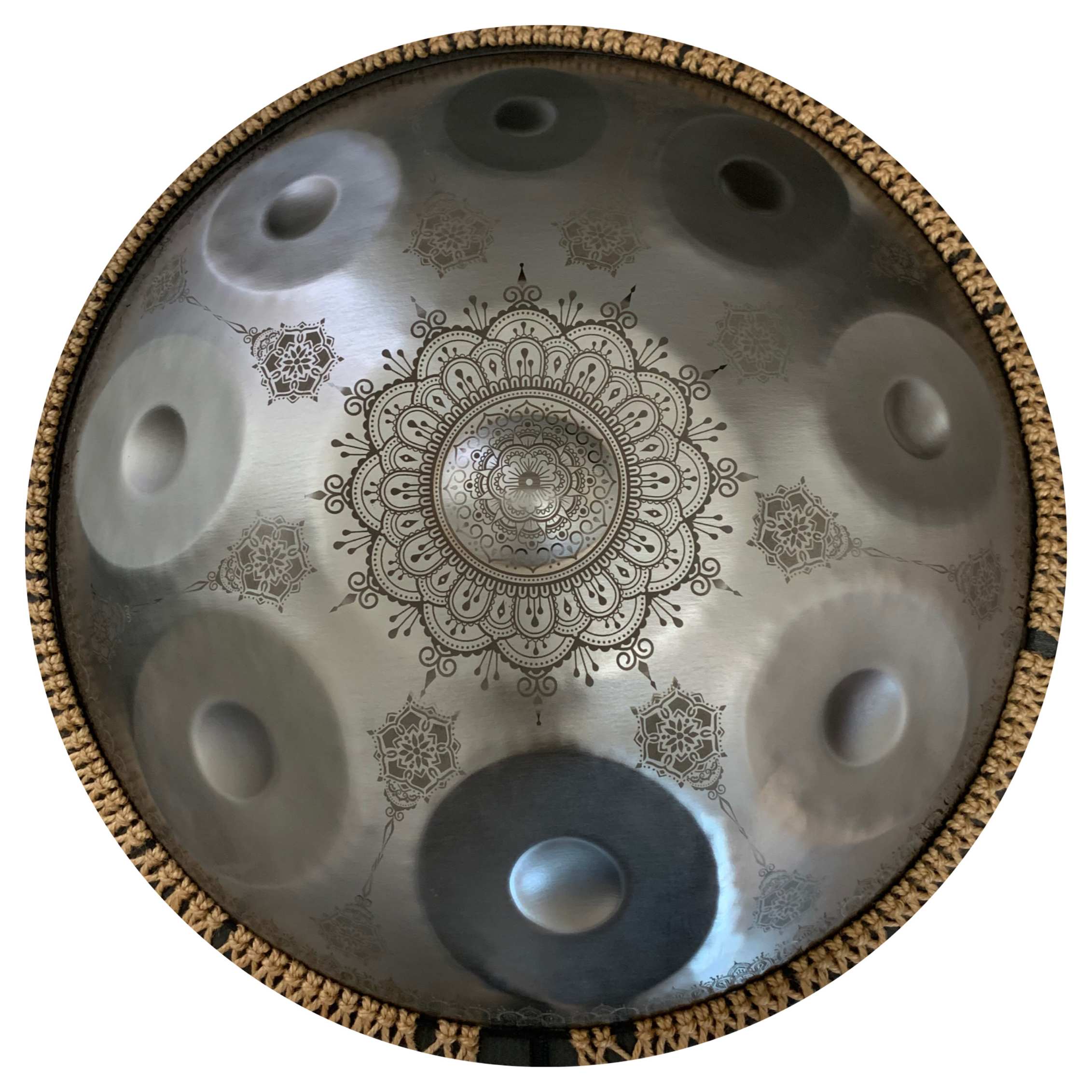
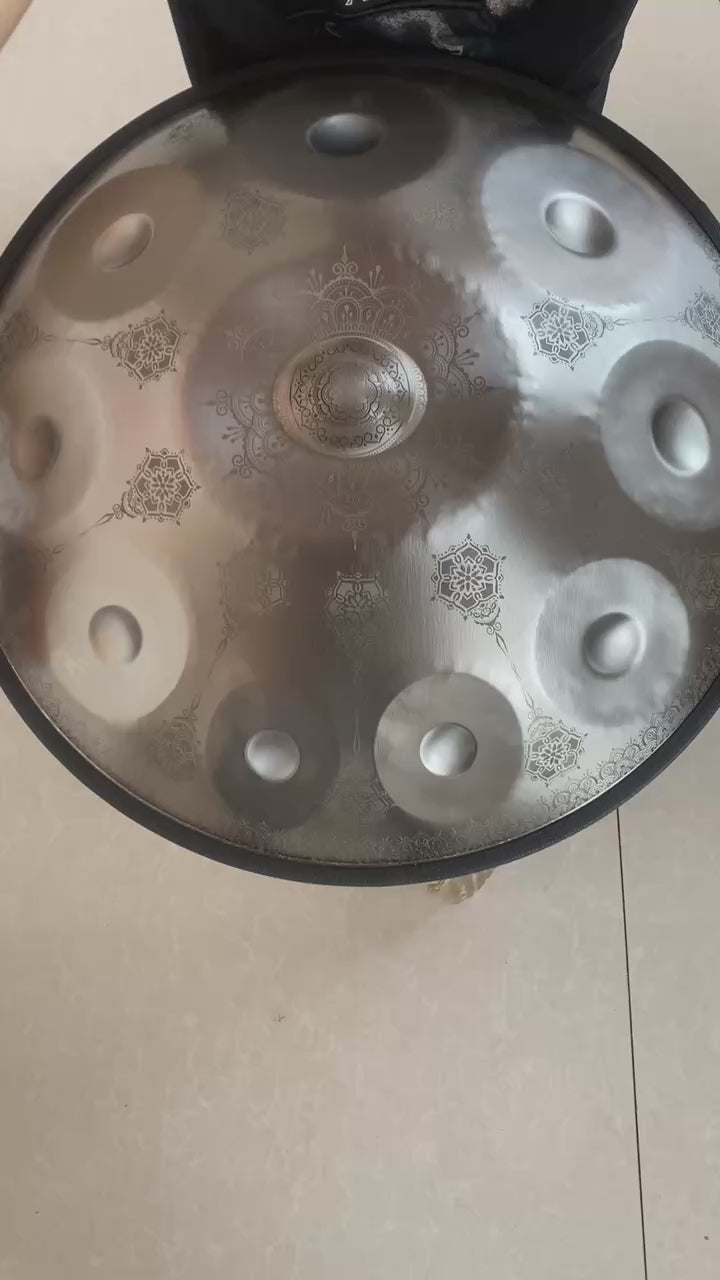
Craftsmanship Spotlight: Cosmos Handpan Golden Elegance 9 Notes D Minor
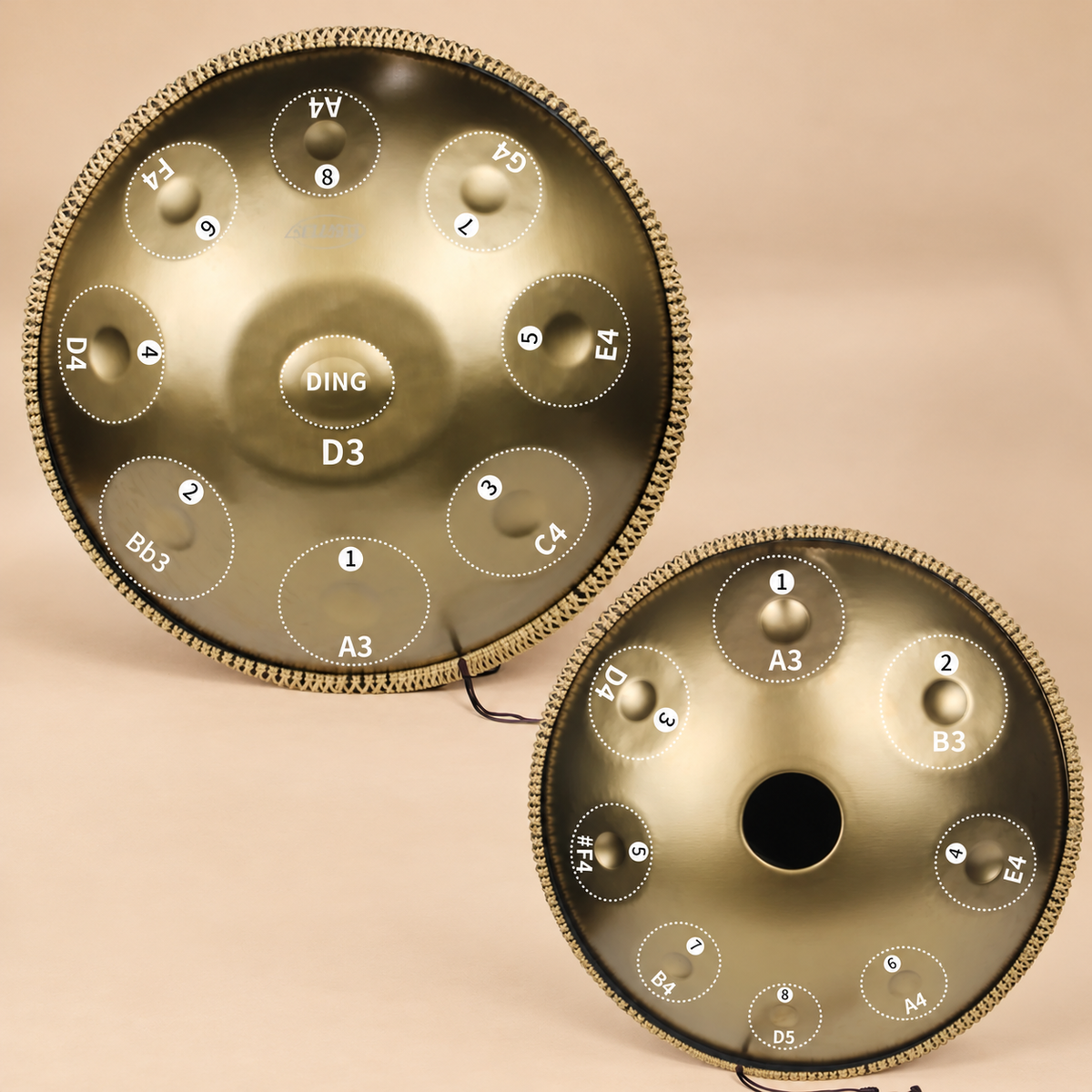
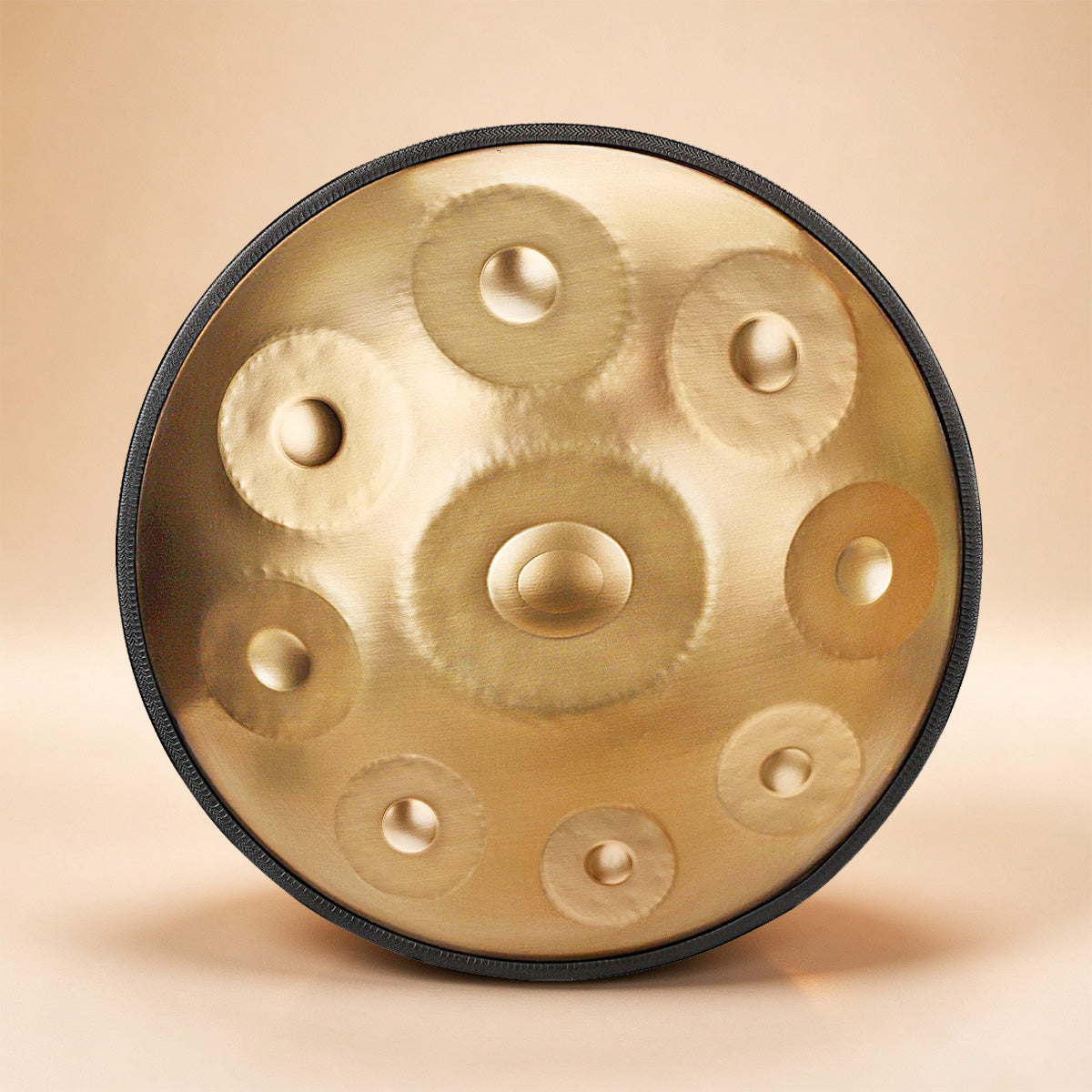
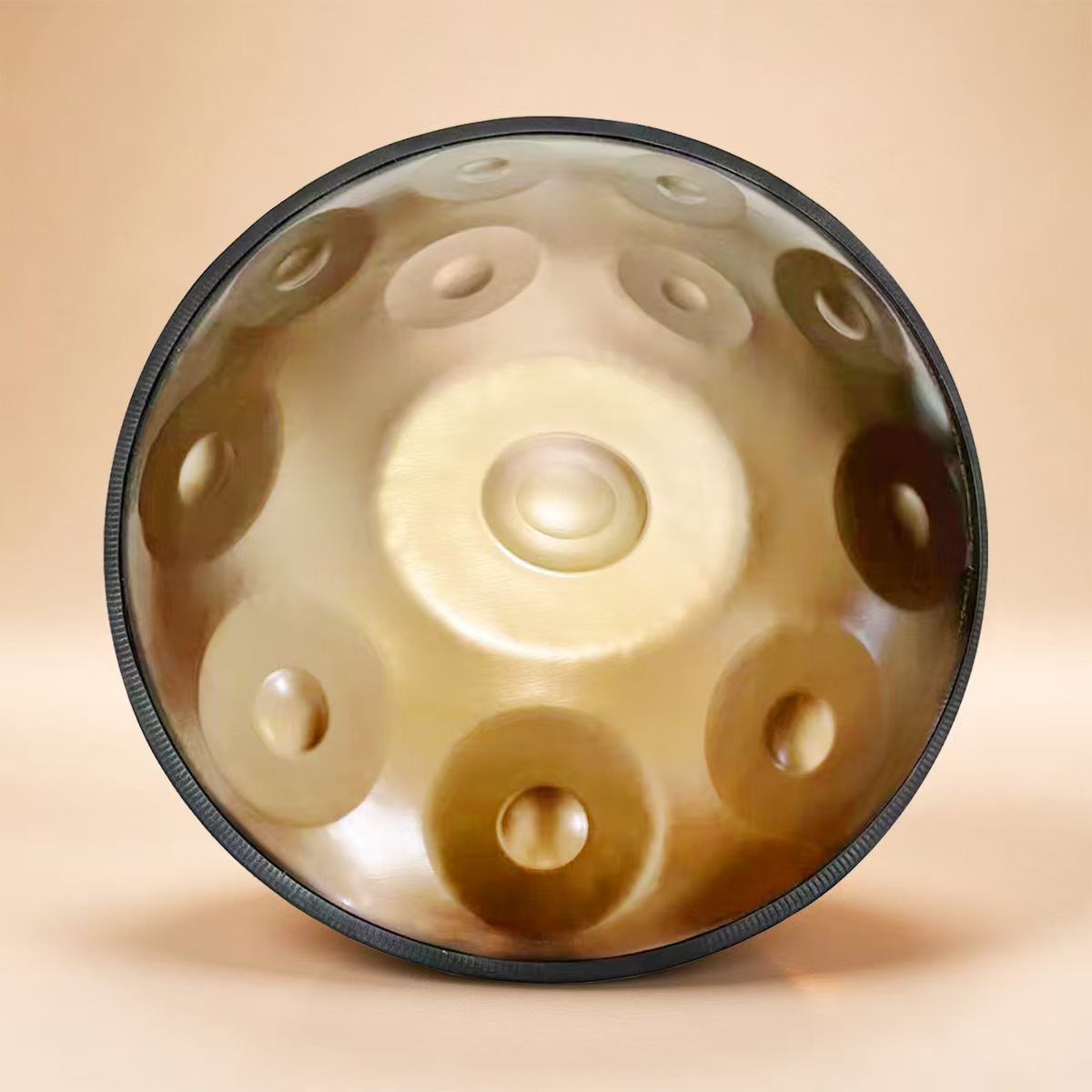
Engineered for first-time buyers, meditation practitioners, and performing artists who demand handcrafted acoustic purity without years of waiting, the Cosmos Handpan Golden Elegance embodies the peak of modern handpan metallurgy.
| Musical Scale Architecture | 9 Notes D Minor (Kurd / Celtic layout: D3 / A3, Bb3, C4, D4, E4, F4, G4, A4) |
| Tuning Standards | Factory calibrated to concert pitch (440Hz) or meditative natural resonance (432Hz) |
| Surface Metallurgy | High-purity stabilized alloy with a scratch-resistant Golden Elegance PVD protective finish |
| Acoustic Resonance Profile | Smooth, calming tone with extended, crystal-clear sustain and balanced dynamic response |
| Ergonomic Dimensions | Standard 22-inch diameter shell engineered for comfortable seated lap play |
| Complete Gift Set Bundle | Includes heavy-duty protective travel bag, foldable aluminum stand, wooden mallets, and care cloth |
Master Tuner's Sourcing Advice: Eliminate the risk of buying out-of-tune novelty drums. Invest in authentic, hand-calibrated sound by ordering the Cosmos Handpan Golden Elegance - 9 Notes D Minor Gift Set directly, or explore entry-level collections via our 9 Notes handpan and mid-tier 10 Notes handpan series.
Direct Technical Comparison: Nitrided Steel vs. Stainless Steel vs. Ember Steel
| Metallurgical Parameter | Nitrided DC04 Low-Carbon Steel | Austenitic Stainless Steel (304) | Specialized Ember Steel |
|---|---|---|---|
| Acoustic Sustain Duration | Short to Medium (3 – 5 seconds decay) | Long & Expansive (8 – 12+ seconds decay) | Balanced Medium-Long (6 – 9 seconds decay) |
| Timbre Character | Earthy, ceramic, focused, warm, punchy | Cathedral-like, ethereal, bright, singing | Deep, resonant, rich fundamental warmth |
| Best Playing Style | Fast, rhythmic, percussive, aggressive | Slow, meditative, sound therapy, chords | Dynamic versatility (Rhythmic + Melodic) |
| Atmospheric Rust Resistance | Moderate (Requires monthly wax/oil care) | Exceptional (Virtually immune to skin sweat) | High (Excellent environmental resistance) |
| Dynamic Touch Sensitivity | Crisp response; handles hard strikes cleanly | Ultra-sensitive; responds to featherlight taps | Balanced; wide dynamic volume range |
| Tuning Longevity Stability | High (Nitrogen crystal lock resists drift) | High (Tensile strength holds pitch firmly) | Extremely High (Engineered specifically for pantams) |
Pros and Cons: Hand-Hammered Artisan vs. Factory Stamped Handpans
| Manufacturing Philosophy | Documented Acoustic Strengths (Pros) | Real-World Operational Liabilities (Cons) |
|---|---|---|
|
Artisan Hand-Hammered Instruments (e.g., Cosmos Handpan Production) |
|
|
|
Mass-Market Stamped Clones (Budget Marketplace Imports) |
|
|
Acoustic Coupling: Harmonics, Boundary Traps, and Wave Isolation
To truly master evaluating the materials handmade handpan builders select, one must understand the phenomenon of acoustic cross-talk and sympathetic resonance. When an instrument has nine or twelve notes arranged across a single interconnected steel shell, striking one note generates transverse bending waves that propagate across the entire hemisphere.
As documented in peer-reviewed physical acoustics literature published by the Journal of the Acoustical Society of America (JASA) on Handpan Acoustics, if adjacent tone fields share complementary frequencies, energy transfers between them through acoustic coupling:
- Sympathetic Resonance (Harmonic Blessing): When you strike the central Ding (D3), it naturally stimulates the higher octave D4 tone field across the shell through sympathetic coupling. A master handpan craftsman tunes the shell so this sympathetic excitation creates an airy, spatial reverberation that makes the instrument sound like a grand piano.
- Acoustic Cross-Talk (Harmonic Curse): If a maker fails to hammer deep, isolated interstitial troughs between adjacent notes, striking a C4 note will unintentionally excite an adjacent D4 note. Because C and D are a dissonant minor second interval, the two notes clash violently, producing a harsh, vibrating metallic rattle.
Achieving clean harmonic isolation requires the craftsman to balance shell thickness and boundary depth. A shell measuring 1.2mm in thickness requires more physical hammer force to deform, but offers superior acoustic isolation between tone fields; a 1.0mm shell is easier to tune and produces brighter sound, but demands surgical boundary control to prevent bleeding. To understand physical shell volumes, consult our technical guide on standard handpan size standards.
Who Needs a Fine Handmade Handpan vs. Who Should Start with a Tongue Drum
Every dollar in a musical instrument budget should align with the player's mechanical expectations and musical goals. Discerning whether you need a fine handmade handpan or an alternative percussion instrument prevents expensive purchasing regret.
Musicians Who Must Invest in a Quality Handmade Handpan:
- Sound Healers, Yoga Instructors & Therapists: Practitioners who utilize pure harmonic sound to induce alpha and theta brainwave relaxation states. Stainless steel handpans tuned to 432Hz provide long, crystalline decay times that fill a studio space with meditative warmth.
- Percussionists & Performing Artists: Musicians who demand nuanced touch sensitivity. A fine handmade handpan responds dynamically: a featherlight finger pad touch produces a whisper of tone, while a sharp knuckle snap generates an explosive, clean acoustic transient without harmonic distortion.
- Serious Hobbyists Seeking Intuitive Expression: Unlike a violin or trumpet that requires months of technical drills just to produce a clean tone, a handpan in an intuitive scale (like D Minor Kurd) is harmonically pre-set: every note harmonizes with every other note. You cannot play a "wrong" note, allowing beginners to experience immediate, joyful musical improvisation.
When You Should Choose a Steel Tongue Drum Instead:
- Children & Elementary Music Classrooms: Young children frequently strike instruments with hard wooden drumsticks or toys. A handpan membrane is delicate and will detune if struck with hard objects. A slotted Tongue Drum (cut from heavy industrial steel cylinders) is virtually indestructible and can be beaten aggressively with rubber mallets without damage.
- Ultra-Low Budget Explorers: If your absolute maximum financial budget is under $200, do not buy a cheap clone handpan online; it will arrive out of tune and frustrate your ears. Purchase a high-quality tuned tongue drum, which delivers beautiful melodic sound at an accessible price point.
Costly Mistakes Buyers Make Sourcing a Handpan
Master Tuner Warning: The "Mallet-Only" Deception
The most common deception in online video advertisements for cheap handpans is showing a demonstrator playing the instrument exclusively with hard rubber or foam mallets. Mallets apply a broad, heavy impact that artificially excites the fundamental frequency of poorly tuned steel, masking the fact that the octave and compound fifth harmonics are completely missing! Always demand to hear a handpan played exclusively with bare human fingers and knuckles. If an instrument only sounds acceptable when struck with mallets, its harmonic tuning is fundamentally flawed.
- Buying Un-Nitrided Carbon Steel Drums: Purchasing a low-cost black handpan that was merely coated with black automotive spray paint rather than true gas-nitrided steel. Within three weeks of contact with humid air and skin oils, the paint chips, rust forms beneath the surface, and the notes lose their pitch stability. Always confirm verified gas nitriding or stainless steel construction.
- Over-Complicating Note Counts on Your First Instrument: Buying an aggressive 14 to 17-note handpan with bottom mutant notes as a total beginner. More notes require smaller tone fields packed tightly together, increasing the risk of accidental cross-strikes and muddying the sound. Start with an intuitive, beautifully balanced 9-note or 10-note layout; master the instrument's dynamic touch before stepping up to advanced 12 Notes handpan platforms.
- Playing with Hard Wooden Drumsticks: Treating a handpan like an African djembe or a steel-pan drum by hitting it with wooden drumsticks, rings, or heavy metal mallets. A handpan membrane is a thin, precision-tuned steel skin. Striking it with rigid materials will dent the tone field dimple, permanently stretching the steel and instantly throwing the octave harmonic out of tune. Play exclusively with clean, bare hands or soft, dedicated yarn mallets.
- Leaving Instruments Sealed in Foam Gig Bags: Storing a handpan inside a foam-padded travel case for months in a damp basement or closet. Foam absorbs atmospheric moisture like a sponge, holding dampness against the steel shell and causing rapid surface corrosion. Travel bags are designed for transport; when storing at home, display the instrument openly on a wooden stand in a climate-controlled room.
Essential Buying Checklist: Auditing Steel Thickness, Tuning & Scale
Before transferring payment or ordering any instrument claiming to represent elite materials handmade handpan craft, evaluate prospective builders against these four non-negotiable standards:
1. Verified Harmonic Calibration Tolerance (±3 Cents)
Demand audio or video proof of individual note testing with an acoustic strobe tuner:
- The fundamental ($1f$), octave ($2f$), and compound fifth ($3f$) must each test within ±3 to ±5 cents of true pitch.
- Test the "shoulder tones": tap the flat perimeter of the tone field along its length and width with a light finger tap to confirm the isolated octave and fifth ring cleanly on their own.
- Review international acoustic standards governed by the ISO 16:1975 Standard Tuning Frequency Specification (Concert Pitch A4 = 440 Hz).
2. Shell Wall Thickness and Alloy Certification
Ensure the manufacturer specifies their sheet metal stock:
- Optimal shell gauge must sit strictly between 1.0mm and 1.2mm. Thinner metal (<0.8mm) sounds tinny and detunes easily; thicker metal (>1.5mm) is stiff, demanding exhausting finger striking force.
- Demand documented alloy verification: either certified DC04 deep-drawing steel with high-temperature gas nitriding, or certified AISI 304/430 austenitic/ferritic stainless steel. Review material deformation and drawing standards through ASTM International: Standard Specification for Steel Sheet, Carbon, Cold-Rolled.
3. Musical Scale Hierarchy and Key Selection
Choose an ergonomic scale matching your musical intentions:
- D Minor (D Kurd / Celtic): The universal standard. Deeply emotive, versatile, and instantly compatible with other handpan players worldwide. Learn the structural theory in our guide to understanding handpan notes.
- Major Scales (E Sabye / F Major): Uplifting, bright, and playful, ideal for morning meditation and cheerful songwriting.
- Exotic Modals (Hijaz / Taraz): Middle-Eastern and cinematic flavors featuring dramatic half-step semitone intervals for experienced players.
4. Total Commercial Value and Support Infrastructure
A legitimate maker stands behind their instruments with post-sale support. Handpans will eventually require retuning after years of play. Verify that your builder offers professional re-tuning services and includes essential accessories—such as heavy-duty padded gig bags, desktop display stands, and microfiber cleaning kits. Compare pricing realities across the market in our detailed study on how much does a handpan cost, and review comprehensive selection parameters in our handpan buying guide.
Expert Sourcing Verdict: The Smart Musician's Roadmap
In our professional assessment across decades of acoustic metal shaping and instrument tuning, the conclusion is absolute: the quality of the materials handmade handpan artisans select directly dictates the soul, stability, and longevity of the instrument. Attempting to cut corners by purchasing unbranded, un-nitrided stamped steel bowls off discount auction sites results in discordant, tinny clatter that will end up collecting dust in a closet.
Here is your clear, actionable procurement roadmap:
- For Meditative Solitude, Sound Therapy, and Long Singing Sustain: Choose Stainless Steel. Its singing sustain, shimmering upper harmonics, and total immunity to skin sweat corrosion make it the most forgiving, rewarding material for mindful, slow playing.
- For Fast, Rhythmic, Percussive Playing: Choose Gas-Nitrided Carbon Steel. Its ceramic, focused transient and rapid decay keep fast 16th-note patterns clear, punchy, and articulate without acoustic mud.
- Stick to the D Minor 9-Note Golden Standard: Start your journey with the world's most versatile, beloved scale. It eliminates harmonic frustration, unlocks intuitive improvisation from your very first session, and connects you with a global community of players.
- Invest in Proven Craftsmanship: Choose a trusted instrument builder like Cosmos Handpan. By ordering an expertly crafted instrument like the Cosmos Handpan Golden Elegance 9 Notes D Minor, you secure certified alloy metallurgy, precision three-harmonic coupling on every note field, durable PVD scratch protection, and a complete turnkey bundle (stand, bag, mallets, and care kit) that guarantees an inspiring acoustic journey for years to come.
Frequently Asked Questions
The choice of steel directly determines timbre, sustain, and corrosion resistance. Nitrided low-carbon steel produces a dry, ceramic, percussive timbre with short-to-medium sustain and high tuning stability against aggressive playing. Stainless steel yields a lush, expansive sustain with shimmering high harmonics and near-complete immunity to sweat corrosion, making it ideal for meditative soundscapes.
Gas nitriding diffuses active nitrogen atoms into the atomic lattice of the steel at temperatures around 520°C to 580°C, creating a hardened compound white layer and diffusion zone. This thermochemical process alters the internal tensile elasticity of the shell, increases fatigue life, protects against atmospheric oxidation, and locks in the fundamental frequencies against thermal drift.
Manual hammer sinking involves stretching flat steel sheets into hemispheres by hand, creating variable work hardening and organic micro-textures that yield an earthy, distinctive acoustic warmth. Hydroforming and deep-drawing use hydraulic fluid or mechanical dies to form uniform shells with consistent wall thickness, which provides repeatable harmonic balance and lower production cost.
A properly nitrided or heat-stabilized stainless handpan played with correct fingertip technique typically requires retuning only once every 2 to 4 years. Instruments subjected to heavy mallet strikes, aggressive slapping, direct desert sun exposure, or drops can slip their compound fifth or octave harmonics sooner.
Authoritative References & Acoustic Engineering Standards
- Journal of the Acoustical Society of America (JASA): The Acoustics of the Hang – Modal Analysis, Compound Harmonics, and Nonlinear Coupling in Steel Idiophones (Thomas D. Rossing et al.)
- ASM International: ASM Handbook Volume 4 – Heat Treating and Surface Engineering: Fundamentals of Gas Nitriding and Nitrogen Diffusion in Sheet Steels
- ASTM International: ASTM A1008 / A1008M Standard Specification for Steel, Sheet, Cold-Rolled, Carbon, Structural, and High-Strength Low-Alloy with Improved Formability